
Split ends, straw-like textures, and frizz are telltale signs that your hair has reached its breaking point. Daily heat styling, chemical coloring, UV radiation, and dry ambient air deplete the natural lipid shield that coats your hair fibers, leaving the delicate ends frayed and porous.
While commercial hair serums and silicones offer a temporary cosmetic glaze, they often coat the strands without repairing the underlying hydration deficit. To truly restore softness, elasticity, and shine, your hair needs a balanced combination of humectant hydration and occlusive lipid protection.
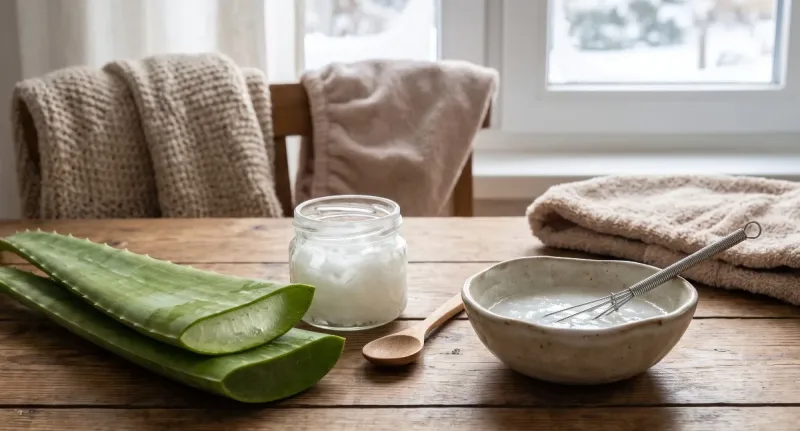
Enter one of nature’s most effective botanical duos: an aloe vera gel and coconut oil mask for dry damaged hair ends. This comprehensive guide explores the hair science behind why this blend works, how to prepare and apply it step-by-step, and how to stop terminal hair breakage naturally at home.
The Anatomy of Damaged Hair Ends: Why Do Ends Dry Out First?
To fix brittle ends, it helps to understand how hair fibers are built. Each strand features three concentric layers:
-
The Medulla: The soft, innermost structural core.
-
The Cortex: The middle fibrous bulk made of keratin protein coils, responsible for elasticity, strength, and hair color.
-
The Cuticle: The outermost protective shield, composed of overlapping shingles of flat, transparent keratin scales, anchored by an ultra-thin layer of lipids called the 18-MEA layer.
Because the ends of your hair are the oldest section of the fiber—often two to four years old—they have endured hundreds of wash cycles, heat exposures, and towel rubbings. Over time, the 18-MEA lipid layer wears away entirely.
Once this protective wax is gone:
-
Cuticle scales lift, chip, and break open.
-
Water escapes rapidly from the internal cortex, leaving hair parched.
-
Friction between neighboring strands escalates, causing horizontal snapping and vertical splitting (trichoptilosis).
Reversing this process requires moisture to enter the cortex, paired immediately with a sealant to lock that moisture inside. That is precisely why combining aloe vera with coconut oil creates synergistic hair repair.
The Science: Why Aloe Vera Gel and Coconut Oil Work Together
Most hair masks fail because they provide only moisture (water) or only oil. Using oil alone on bone-dry ends often leads to greasy, stiff strands because oil cannot hydrate; it only lubricates and seals. Using water or aloe alone results in rapid evaporation, leaving the hair as dry as before.
The combination of aloe vera gel and coconut oil forms a complete bi-phasic conditioning treatment:
Aloe Vera: The Ultimate Humectant & Enzymatic Healer
-
75+ Active Nutrients: Pure aloe vera inner leaf gel is packed with vitamins A, C, and E (antioxidants), vitamin B12, folic acid, and essential amino acids that mimic hair keratin.
-
Humectant Polysaccharides: Mucopolysaccharides (such as acemannan) attract ambient moisture molecules and pull them directly into the dehydrated cortex.
-
Optimal Low pH: Aloe has a naturally acidic pH around 4.5. This matches the biological pH of healthy hair, helping force raised, damaged cuticle scales flat against the hair shaft, restoring instant light reflection (shine) and minimizing snags.
-
Proteolytic Enzymes: Natural enzymes clear dead cell debris and soothe the cuticle surface.
Coconut Oil: The Deeply Penetrating Lipid Shield
-
Lauric Acid Affinity: Most vegetable oils (such as mineral oil, sunflower oil, or argan oil) sit on the surface of the hair shaft because their molecular structures are too bulky. Coconut oil is rich in lauric acid, a medium-chain triglyceride with a compact, linear chemical structure.
-
Keratin Affinity: Lauric acid possesses a high affinity for hair keratin proteins, allowing it to bypass the cuticle and penetrate straight through into the internal cortex.
-
Protein Loss Prevention: Decades of cosmetic chemistry research confirm that coconut oil dramatically reduces protein loss in both undamaged and chemically treated or bleached hair fibers.
-
Hydrophobic Seal: Once inside and around the shaft, it repels excess external humidity (preventing frizz) while locking the aloe's water content within the hair shaft.
How to Make and Apply the Mask (Step-by-Step)
Creating this restorative treatment takes five minutes. For optimal results, use pure, cold-pressed, unrefined extra virgin coconut oil and organic, preservative-free aloe vera inner leaf gel.
The Ideal Repair Ratio
Because damaged ends need concentrated care, use a balanced 1:1 or 2:1 ratio depending on hair thickness:
-
Fine to Medium Hair: 2 tablespoons pure aloe vera gel + 1 tablespoon melted coconut oil (lighter feel).
-
Thick, Coarse, or Chemically Treated Hair: 2 tablespoons pure aloe vera gel + 2 tablespoons melted coconut oil.
| Hair Type / Damage Level | Aloe Vera Gel | Coconut Oil | Recommended Frequency | Leave-In Duration |
| Fine / Mild Split Ends | 2 Tbsp | 1 Tbsp | Once every 10–14 days | 20–30 minutes |
| Normal / Heat-Stressed | 2 Tbsp | 1.5 Tbsp | Once weekly | 30–45 minutes |
| Coarse / Bleached / Fragile | 2 Tbsp | 2 Tbsp | 1–2 times weekly | 45–60 minutes (or overnight) |
| Low Porosity Ends | 3 Tbsp | 1 Tsp (melted warm) | Once weekly | 20 minutes (with warm towel) |
Preparation Instructions
-
Melt the Oil: If your coconut oil is solid, gently warm it in a glass bowl set over warm water until it turns into a clear liquid. Avoid microwaving it to high temperatures to protect the fatty acid integrity.
-
Whisk with Aloe: Add the fresh or pure aloe vera gel into the warm oil.
-
Emulsify: Whisk vigorously using a small fork or cosmetic whisk until the clear liquid and gel transform into a cloudy, milky, silky emulsion. Emulsifying prevents the oil and water from separating during application.
Step-by-Step Application
-
Dampen the Ends: Lightly mist the bottom 3 to 6 inches of your hair with lukewarm water. Applying the mask to lightly damp hair maximizes the humectant power of the aloe vera.
-
Work from the Bottom Up: Scoop a generous coin-sized amount of the emulsion onto your palms. Smooth it over the very tips of your hair first, then gently work your way upward toward mid-lengths. Keep the mixture away from your scalp and roots unless you are doing a pre-shampoo scalp treatment.
-
Detangle with Care: Use a wide-tooth seamless wooden comb or your fingers to distribute the mask evenly through every strand.
-
Wrap and Trap Heat: Twist your treated ends upward, secure with a soft claw clip, and cover your hair with a shower cap. Wrap a warm, damp towel around the shower cap. Gentle warmth expands the cuticle slightly, helping the lauric acid and acemannan penetrate deep into the cortex.
-
Wait: Leave the mask on for 30 to 45 minutes (or up to 2 hours for severely bleached ends).
-
Rinse and Cleanse: Rinse thoroughly with lukewarm water. Follow with a gentle, sulfate-free shampoo to lift residual surface oil. You may find you do not need a commercial rinse-out conditioner afterward.
4 Pro Tips to Maximize End Repair
-
Add 2 Drops of Vitamin E or Argan Oil: If your ends are bleached or chemically straightened, adding two drops of pure d-alpha-tocopherol (Vitamin E) or argan oil boosts thermal defense against free-radical oxidation.
-
Adjust for Hair Porosity:
-
High porosity hair (absorbs water instantly, dries fast, feels rough) loves a richer 1:1 coconut-to-aloe balance.
-
Low porosity hair (resists moisture, takes hours to dry) struggles with heavy oils. Use a 3:1 aloe-to-coconut ratio and always apply warmth to help it absorb.
-
-
Avoid Hot Water Rinses: Always wash the mask out with cool or lukewarm water. Hot water lifts cuticles and strips away the fatty acids you just deposited.
-
Follow the "Search and Destroy" Trimming Habit: Remember that while aloe and coconut oil temporarily bond, seal, and smooth split ends, no topical ingredient can permanently weld a severed hair shaft back together. Pair this mask with occasional micro-trims using sharp hair shears to eliminate true bifurcated splits before they travel up the hair shaft.
Daily Habits to Prevent Ends from Breaking
-
Sleep on Mulberry Silk or Satin: Cotton pillowcases create high friction that strips hair oils and frays cuticles during sleep. Silk or satin allows hair ends to glide smoothly without snagging.
-
Ditch the Terry Cloth Towel: Rough cotton loop towels rip lifted cuticles. Swap them for a smooth microfiber hair wrap or an old soft cotton T-shirt, and gently squeeze excess water instead of rubbing.
-
Use Protective Styles: If your hair touches your shoulders or back, friction against synthetic clothing fabrics dries out the tips. Wear loose buns, braids, or French twists secured with soft satin scrunchies.
-
Keep Heat Below 350°F (175°C): Heat styling above this threshold causes moisture inside the cortex to boil, creating microscopic bubbles in the hair shaft (bubble hair deformity) that cause instant breakage.
Medical Disclaimer:The hair care formulations, botanical remedies, and instructions outlined in this article are intended solely for educational and cosmetic informational purposes and do not substitute for professional medical, dermatological, or trichological advice. If you experience severe scalp irritation, unexplained sudden hair shedding, or persistent dermal inflammation, consult a board-certified dermatologist or certified trichologist immediately. Always conduct a small 24-hour skin patch test behind your ear before using new raw botanicals or oils to rule out contact allergic reactions.



Comments
No comments yet. Be the first to ask a question or share an update.
Leave a comment
Your mobile number is never published. Comments appear after review. Website links, email addresses and code are not allowed.