
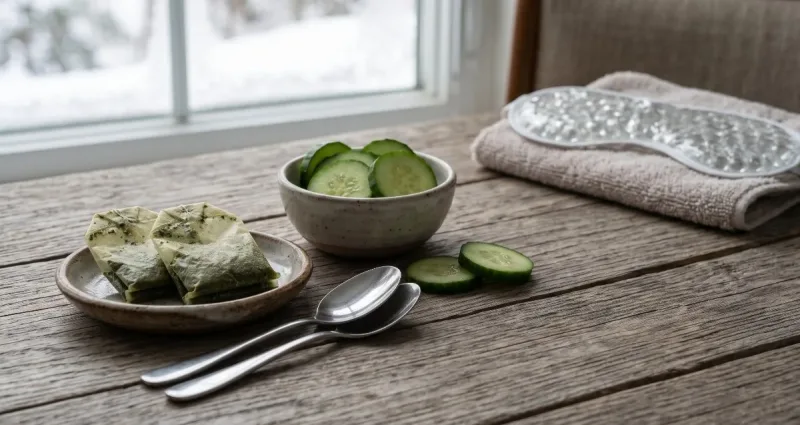
Waking up, looking in the mirror, and greeting a pair of swollen, puffy lower eyelids is a frustrating start to any morning. Whether caused by a late evening out, poor sleep quality, high-sodium dinners, seasonal allergies, or simply crying before bed, morning periorbital edema (fluid retention around the eye sockets) can make you look exhausted even when you feel ready for the day.
While caffeinated serums and eye roll-ons have their place in a skincare cabinet, few remedies work faster or more reliably than temperature-based interventions. Cold therapy acts directly on the microvascular structures surrounding the ocular orbit.
By applying targeted cold compress methods to quickly soothe swollen puffy eyes in morning, you can rapidly constrict expanded blood vessels, mobilize stagnant interstitial fluid, and brighten your entire face within minutes.
The Physiology of Morning Eye Swelling: Why Does Fluid Pool Overnight?
To maximize the benefits of cold therapy, it helps to understand why the eye contour is so vulnerable to morning swelling.
The skin encompassing your orbital rim is the thinnest, most delicate dermal tissue on the human body, measuring a mere 0.5 millimeters thick. Beneath this delicate barrier sits a complex network of tiny capillary loops, loose subcutaneous connective tissue, and a specialized lymphatic drainage system.
When you sleep, several physiological shifts occur:
-
Loss of Gravity-Assisted Drainage: When standing or sitting upright during daylight hours, gravity pulls venous blood and lymphatic fluid downward toward the heart and lymph nodes. Lying flat for seven to eight hours eliminates this passive drainage, allowing interstitial fluid to seep into loose under-eye tissue.
-
Reduced Blinking and Muscle Inactivity: The orbicularis oculi muscles (the circular muscles surrounding your eye sockets) contract thousands of times a day via blinking. This continuous pumping action acts as an internal engine for your lymphatic channels. During sleep, your eyes stay mostly closed, shutting down the muscular pump and allowing fluid to pool.
-
Osmotic Shifts from High Sodium and Dehydration: Consuming salty foods or alcohol before bed increases serum sodium levels. To maintain biological homeostasis, your body holds onto water, preferentially depositing excess fluid within loose, highly elastic compartments like the periorbital beds.
-
Histamine and Inflammation: Seasonal environmental allergies or contact irritants prompt mast cells to release histamine. Histamine dilates local capillaries and makes their walls porous, flooding surrounding dermal compartments with plasma.
Cold compresses interrupt this chain reaction at a vascular level.
The Science of Cold Therapy: Vasoconstriction and Lymphatic Pumping
Applying cold temperatures to the periorbital zone triggers an immediate biological reaction known as cryo-induced vasoconstriction.
When smooth muscle cells lining your microcapillaries register cold, they contract rapidly. This narrowing of the blood vessels produces two immediate outcomes:
-
Stops Fluid Leakage: Vessel permeability drops, preventing additional plasma and fluid from leaking out of capillaries into surrounding connective tissue.
-
Reduces Redness and Heat: Dilated blood vessels that create a flushed, dark, or purplish under-eye cast shrink out of view, visibly brightening the skin.
Furthermore, once the cold source is removed after several minutes, the body responds with a gentle, controlled rebound circulation. Fresh, oxygenated blood flows into the area, carrying cellular waste and fluid toward facial lymph nodes.
Cold also temporarily slows nerve conduction velocity along local C-fibers, numbing that tight, heavy, or itchy sensation often accompanying allergy-induced swelling.
7 Proven Cold Compress Methods for Fast Morning Relief
1. The Chilled Ceramic or Metal Teaspoon Press
One of the most accessible and effective methods for morning swelling requires nothing more than two standard stainless steel or silver teaspoons. Metal holds cold temperatures exceptionally well and fits neatly against the orbital bone.
-
How to Prepare: Place two clean teaspoons in the refrigerator for 10 to 15 minutes, or in the freezer for 5 minutes. (Avoid freezing metal too long; it should be cold, never frozen enough to stick to delicate skin).
-
The Technique: Close your eyes and gently press the curved, convex backs of the spoons against your inner lower eye corners. Slowly glide the spoons along the orbital bone toward your temples using featherlight pressure.
-
Duration: Perform this gentle sweeping motion for 3 to 5 minutes per eye.
-
Why it works: The smooth contour of the spoon combines cold-induced vasoconstriction with light manual lymphatic drainage, pushing stagnant fluid outward toward preauricular lymph nodes in front of the ears.
| Method | Temperature Profile | Best For | Application Time |
| Chilled Spoons | Rapid, intense cold | Fast fluid drainage along the orbital bone | 3–5 minutes |
| Caffeinated Tea Bags | Moderate cold + bioactive compounds | Blood vessel constriction and dark shadow reduction | 10 minutes |
| Gel Eye Mask | Even, broad coverage | General full-face exhaustion and waking up | 10–15 minutes |
| Chilled Cucumber Slices | Mild cold + high water content | Sensitive, allergy-prone, or dry morning eyes | 10–12 minutes |
| Iced Chamomile Towel | Gentle, damp cold | Red, stinging, or irritated eyelids | 8–10 minutes |
2. Caffeinated Green or Black Tea Bag Compresses
Tea bags combine thermal cooling with topical phytotherapy. Green and black teas are rich in caffeine and specialized antioxidant polyphenols called tannins.
Caffeine functions as an active topical vasoconstrictor, while tannins work as natural astringents that gently tighten slack dermal tissue.
-
How to Prepare: Steep two bags of organic green or black tea in hot water for two minutes to activate the botanical compounds. Squeeze out excess liquid, place them on a clean saucer, and chill them in the refrigerator for 10 minutes.
-
The Technique: Lie down, close your eyes, and place one chilled tea bag over each eye, ensuring it covers both the upper eyelid and the lower orbital area.
-
Duration: Relax for 10 minutes while breathing slowly.
-
Pro Tip: Keep an eye out for organic varieties free from artificial flavorings or fragrances to avoid accidental chemical contact with your conjunctiva.
3. The Hydrogel or Reusable Gel Bead Mask
For an effortless morning habit, a reusable medical-grade silicone or gel-bead eye mask kept permanently in your refrigerator door is an invaluable tool.
-
How to Prepare: Always store the mask in the main refrigerator compartment rather than the deep freezer. Liquid frozen solid against the eyelids can cause frostburn or damage delicate corneal structures.
-
The Technique: Place the chilled mask over your upper face while sipping morning water or resting before your shower.
-
Duration: 10 to 12 minutes is sufficient to cool periorbital tissue, reduce pooling, and tighten skin without over-chilling.
4. Cold Cucumber Slices with Natural Botanical Actives
The classic spa image of chilled cucumber rounds on the eyes is backed by legitimate dermatological science.
Cucumbers consist of roughly 95% water, giving them high heat capacity that holds a cool temperature steadily. They also contain trace amounts of ascorbic acid (vitamin C) and caffeic acid, natural compounds that soothe irritated tissues and reduce fluid retention.
-
How to Prepare: Cut two thick slices (roughly half an inch thick) from a chilled cucumber.
-
The Technique: Place the rounds over your closed eyes while leaning your head back. When the surface facing your skin warms up after 5 minutes, flip the slices over to the cool side for another 5 minutes.
-
Duration: 10 minutes total.
-
Bonus: The natural juices deliver light hydration to parched morning eyelids without leaving a sticky or oily film.
5. Iced Chamomile Infusion Cloth
If your swollen eyes are also accompanied by stinging, itching, or redness—typical of morning dust or pollen allergies—pure cold water might not be enough. Chamomile contains natural anti-inflammatory compounds, including chamazulene and bisabolol.
-
How to Prepare: Brew a strong cup of pure whole-flower chamomile tea. Let it cool, drop two ice cubes into the liquid, and soak a soft, 100% organic cotton washcloth or reusable cotton rounds in the brew.
-
The Technique: Wring out excess moisture so the cloth is damp rather than dripping. Fold it over your eyes and bridge of your nose.
-
Duration: 8 to 10 minutes.
-
The Result: The cold halts histamine-mediated swelling, while bisabolol calms surface inflammation.
6. The Ice Cube Milk Compress (Lactic Acid + Cold)
Cold whole milk or unsweetened almond milk offers a two-in-one remedy for eyes that are both swollen and dry or flaky.
The cold liquid reduces fluid retention, while the natural fats and proteins in milk calm damaged barriers. In whole cow's milk, gentle amounts of naturally occurring lactic acid (an alpha-hydroxy acid) provide mild, non-abrasive smoothing over rough morning skin.
-
How to Prepare: Pour 2 tablespoons of cold milk into a small dish with an ice cube. Soak two clean cotton pads in the mixture for 60 seconds.
-
The Technique: Squeeze gently and press the damp pads beneath your eyes along the lower orbital bone.
-
Duration: Leave on for 5 to 7 minutes. Rinse your face with cool, fresh water afterward to remove milk proteins.
7. Gentle Ice Roller Sculpting
Ice rollers made of stainless steel or frozen gel cores provide continuous cold while gliding across facial contours.
-
The Technique: Start at the inner corner of the lower eye orbit. With featherlight pressure, roll outward toward the hairline, down past the front of the ear, and along the side of the neck.
-
The Biological Pathway: This path follows your body's natural facial lymphatic drainage channels, escorting pooled fluid down toward the thoracic duct for systemic clearance.
-
Duration: Roll each side for 2 minutes. Never press hard; dragging the roller aggressively stretches delicate skin.
4 Mistakes to Avoid When Using Cold Compresses on Eyes
-
Never Apply Direct Ice to Naked Eye Skin: Applying raw ice directly to the eyelids can cause cold-induced skin injury (erythema pernio) or damage the delicate epithelial cells of your cornea. Always wrap an ice cube in a soft cotton handkerchief or use chilled, non-frozen tools.
-
Avoid Heavy Pressure: The skin beneath your eyes contains no thick layer of fat to cushion forceful contact. Pushing spoons, rollers, or ice bags down with firm pressure bruises microcapillaries, leading to dark under-eye circles (post-inflammatory hyperpigmentation).
-
Do Not Leave Compresses On Indefinitely: Cold therapy works best in concise intervals. Leaving an intense cold compress on your eyes for longer than 15 to 20 minutes triggers a reflex called the "hunting reaction" (cold-induced vasodilation), where blood vessels rapidly widen to protect the tissue from freezing, making swelling worse.
-
Skipping Post-Compress Hydration: Cold water rapidly evaporates into indoor air, taking native moisture from your skin with it. Once you finish your cold compress, apply a drop of lightweight, non-comedogenic oil (like squalane or jojoba) or an eye serum to damp skin to trap hydration inside.
Daily Morning Routine to Clear Eye Puffiness in Under 15 Minutes
-
Minute 0–2: Drink a large glass of room-temperature water. Hydrating immediately prompts your kidneys to begin processing excess sodium and water retention.
-
Minute 2–7: Apply chilled green tea bags or cold spoons across your closed eyelids. Keep your head slightly elevated while resting.
-
Minute 7–10: Use your ring finger to tap outward from the tear duct toward your temples to encourage remaining fluid down the lymphatic pathway.
-
Minute 10–12: Rinse your face with lukewarm or cool water, avoiding harsh, drying foaming cleansers.
-
Minute 12–15: Pat skin so it remains damp, and immediately seal with a lightweight, fragrance-free moisturizer or a single drop of plant squalane.
Medical Disclaimer:The techniques, remedies, and instructions detailed in this article are intended for general educational and cosmetic purposes only and should not be used as medical advice or clinical diagnosis. Sudden, painful, or asymmetrical eye swelling can indicate an underlying medical condition, such as orbital cellulitis, thyroid eye disease, blepharitis, kidney dysfunction, or acute allergic reactions. If your swollen eyes are accompanied by vision changes, discharge, severe pain, or do not improve with basic care, consult an ophthalmologist, optometrist, or primary care physician immediately.




Comments
No comments yet. Be the first to ask a question or share an update.
Leave a comment
Your mobile number is never published. Comments appear after review. Website links, email addresses and code are not allowed.