
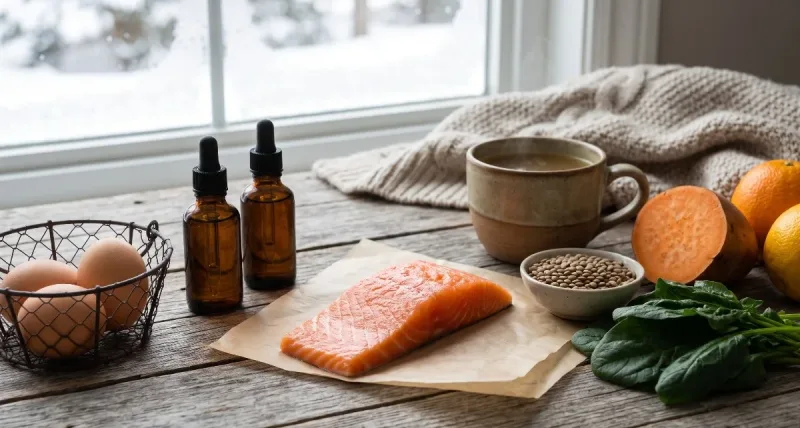
Finding an alarming cluster of loose strands tangled in your shower drain, caught in your comb, or scattered across your pillow is an unsettling experience. When the seasons shift—most notably during late summer transitioning into autumn, or winter giving way to early spring—many people watch their daily hair fall double or even triple.
This widespread phenomenon is known as seasonal hair shedding (a temporary form of telogen effluvium). While an increase in shedding during seasonal transitions has evolutionary and circadian roots, excessive, protracted hair fall often indicates that your hair follicles lack the vital micronutrients required to anchor roots firmly and sustain active growth.
Instead of masking the issue with heavy styling products or silicones, the most sustainable way to halt hair loss is to support the hair cycle from within. Supplying your body with the right essential vitamins to help reduce excessive seasonal hair shedding nourishes the dermal papilla, extends the growth phase, and prevents follicles from shifting prematurely into dormancy.
The Biology of the Hair Cycle: Why Do We Shed More Seasonally?
To understand how vitamins help stop excess hair fall, it helps to examine how the human hair growth cycle operates. Every hair follicle on your scalp cycles independently through four distinct biological phases:
-
Anagen (Growth Phase): The active production window where follicular matrix cells divide rapidly to build the hair shaft. This phase typically lasts between two to seven years and accounts for 85% to 90% of the hairs on your head at any given time.
-
Catagen (Transition Phase): A short, two-to-three-week phase where active growth stops, the hair follicle shrinks, and the root detaches from its local blood supply to form a "club hair."
-
Telogen (Resting Phase): A dormant phase lasting roughly two to four months where the hair strand sits resting in the follicle while a new anagen bud forms beneath it.
-
Exogen (Shedding Phase): The final step where the resting club hair releases from the scalp and falls out, making way for new growth. Normally, losing 50 to 100 strands per day is completely typical.
The Evolutionary Trigger Behind Seasonal Shedding
Clinical trichology research reveals that humans experience a natural peak in the percentage of telogen (resting) hairs around July and August. Evolutionary biologists suggest this was an innate adaptation designed to provide a dense canopy of hair to shield the scalp against intense mid-summer ultraviolet radiation.
Roughly 80 to 100 days after this mid-summer resting phase begins, those hairs naturally enter the exogen phase. This triggers a noticeable wave of hair shedding during autumn (October and November). A secondary, smaller shedding peak often appears in late winter or early spring as the body adapts to fluctuating daylight and temperature shifts.
However, when key micronutrients are running low, this normal seasonal turnover spirals into excessive shedding. Lacking foundational vitamins, follicles that shed are unable to transition promptly back into anagen, leading to overall thinning, widening parts, and sluggish regrowth.
7 Essential Vitamins and Micronutrients to Stop Seasonal Hair Shedding
1. Vitamin D3 (The Follicle Awakener)
Vitamin D is technically a fat-soluble secosteroid hormone rather than a standard vitamin, and its role in hair follicle biology is indispensable.
-
How It Works: Hair follicles contain specialized Vitamin D Receptors (VDR). Vitamin D signaling is directly responsible for stimulating resting stem cells in the follicle bulb, initiating the transition from the dormant telogen phase back into the active anagen growth phase.
-
The Seasonal Connection: As autumn and winter arrive, sunlight exposure drops dramatically, causing serum 25-hydroxyvitamin D levels to plummet. This seasonal dip deprives hair roots of critical activation signals, locking shedding follicles into prolonged rest.
-
Dietary Sources: Wild-caught salmon, sardines, egg yolks, fortified dairy or plant milks, and UV-exposed mushrooms.
-
Target Levels: Many dermatologists recommend maintaining blood serum 25(OH)D levels between 40 and 60 ng/mL for optimal hair growth.
| Vitamin / Micronutrient | Primary Role in Follicle Biology | Impact on Seasonal Shedding | Best Dietary Sources |
| Vitamin D3 | Stimulates VDR stem cells | Awakens dormant roots back into anagen | Salmon, egg yolks, safe sunlight |
| Biotin (B7) & B-Complex | Keratin synthesis & RBC formation | Delivers oxygen and protein to matrix cells | Whole eggs, lentils, sunflower seeds |
| Vitamin C | Collagen synthesis & iron absorption | Blocks free radicals; maximizes ferritin uptake | Bell peppers, citrus, strawberries |
| Vitamin E | Lipid antioxidant & microcirculation | Reduces scalp oxidative stress by over 30% | Almonds, avocado, wheat germ oil |
| Iron (Ferritin) | Hemoglobin synthesis for matrix oxygen | Stops premature follicle dormancy | Pasture-raised red meat, spinach, lentils |
| Zinc | Enzymatic RNA/DNA protein synthesis | Rebuilds follicle structures after shedding | Pumpkin seeds, oysters, chickpeas |
2. Vitamin B7 (Biotin) and the B-Complex Family
While biotin gets the spotlight in hair care, the entire B-vitamin complex acts as an interconnected metabolic engine for your follicles.
-
Biotin (Vitamin B7): Acts as an indispensable coenzyme for carboxylase enzymes involved in fatty acid metabolism and amino acid catabolism. It provides the building blocks for keratin, the structural protein that comprises 85% to 90% of the hair shaft.
-
Cobalamin (B12) and Folate (B9): Follicular matrix cells are among the fastest dividing cells in the entire human body. B12 and folate are essential for DNA synthesis and red blood cell production. Without adequate red blood cells, the micro-capillaries supplying your scalp cannot deliver enough oxygen and fuel to maintain growing roots.
-
Niacin (B3) and Pantothenic Acid (B5): Improve blood circulation across the scalp and support follicular cellular respiration.
-
Dietary Sources: Pasture-raised eggs, organ meats, nutritional yeast, legumes, leafy greens, and whole grains.
3. Vitamin C (The Antioxidant and Iron Enhancer)
Vitamin C (ascorbic acid) is a vital water-soluble antioxidant that protects hair follicles from external seasonal challenges.
-
Collagen Production: Hair fibers are embedded in the dermis, which is supported by a rich collagen extracellular matrix. Vitamin C is a mandatory cofactor for prolyl and lysyl hydroxylase, the enzymes that stabilize collagen triple-helix structures surrounding hair roots.
-
Enhancing Iron Bioavailability: Iron deficiency is one of the leading drivers of excessive hair shedding, particularly in women. Non-heme iron from plant sources has low absorption rates, but consuming Vitamin C concurrently converts non-heme ferric iron into the easily absorbable ferrous form.
-
Neutralizing Environmental Stress: Cold winds and dry heated air generate oxidative free radicals that weaken the outer lipid cuticle of the hair and trigger inflammation in the scalp. Vitamin C directly neutralizes these reactive species.
-
Dietary Sources: Acerola cherries, guavas, red and yellow bell peppers, broccoli, kiwi, and citrus fruits.
4. Vitamin E (Alpha-Tocopherol)
Oxidative stress on the scalp has been directly linked to premature hair fall and early catagen induction.
-
How It Works: Vitamin E is a lipid-soluble antioxidant that integrates directly into the cell membranes of follicular tissue. It prevents the peroxidation of delicate sebum lipids that nourish the scalp.
-
Clinical Evidence: Research demonstrates that volunteers taking mixed tocotrienols (members of the Vitamin E family) showed a 34.5% increase in hair count compared to a placebo group, primarily due to the reduction of lipid peroxidation and oxidative stress in the scalp.
-
Dietary Sources: Raw almonds, sunflower seeds, hazelnuts, avocado, and unrefined wheat germ oil.
5. Vitamin A (The Natural Sebum Balancer)
All cells require Vitamin A for growth, including hair matrix cells. However, balance is vital.
-
How It Works: Vitamin A supports the production of healthy, balanced sebum—the natural lipid shield that coats the hair fiber, seals in moisture, and maintains an optimal acidic environment on the scalp. A deficiency leads to a dry, flaky, irritated scalp and brittle hair fibers that snap easily.
-
A Word of Caution on Over-Supplementation: Unlike water-soluble vitamins, preformed Vitamin A (retinol) is stored in the liver. Taking excessively high doses of synthetic Vitamin A is a known trigger for acute hair shedding. Focus on dietary provitamin A carotenoids, which your body safely converts into active Vitamin A only as needed.
-
Dietary Sources: Sweet potatoes, carrots, butternut squash, spinach, and dark leafy greens.
6. Iron and Ferritin: Oxygen Delivery for Hair Roots
Although classified as a mineral, iron works synergistically with vitamins to prevent excessive seasonal hair shedding.
-
Why Ferritin Matters: Ferritin is the cellular protein that stores iron for your body to draw upon. If your serum ferritin levels drop below 40–50 ng/mL, your body considers hair growth a non-essential function and diverts iron away from the hair matrix to prioritize critical organs like the heart and lungs.
-
The Result: Deprived of oxygen, follicles prematurely abort the anagen growth phase and shift into telogen, creating a wave of diffuse shedding across the entire scalp.
-
Dietary Sources: Grass-fed beef, pasture-raised poultry, lentils, spinach, and pumpkin seeds (always paired with Vitamin C to maximize uptake).
7. Zinc (Enzymatic Repair and Tissue Integrity)
Zinc is an essential trace element that operates as a structural component and cofactor for more than 300 enzymes in the human body.
-
How It Works: Zinc plays a key role in RNA and DNA synthesis, which is crucial for the rapid cellular division occurring inside hair follicle bulbs. Zinc also inhibits hair follicle regression during the catagen phase.
-
Common Signs of Low Zinc: White spots on fingernails, slow-healing wounds, a dry and inflamed scalp, and diffuse hair shedding.
-
Dietary Sources: Oysters, grass-fed beef, raw pumpkin seeds (pepitas), hemp seeds, and chickpeas.
4 External Daily Habits to Protect Fragile Shedding Strands
While nourishing your hair follicles from within with essential vitamins, you must protect your existing hair strands externally to avoid unnecessary mechanical tension:
-
Avoid High-Tension Hairstyles: Tight ponytails, slicked-back buns, and tight braids exert continuous traction on hair follicles. When hair is already resting in the delicate telogen phase, excess mechanical pull dislodges hairs prematurely. Opt for loose styles secured with soft silk or satin scrunchies.
-
Switch to a Wide-Tooth Comb: Never aggressively brush wet hair. Wet hair expands and stretches up to 30% beyond its original length, making it vulnerable to snapping. Use a seamless wide-tooth wooden comb or a flexible detangling brush, working gently from the tips upward to the roots.
-
Turn Down the Shower Heat: Steaming hot water strips the scalp's natural lipid barrier and dehydrates hair fibers. Wash your hair with lukewarm water, finishing with a cool rinse to close cuticle scales.
-
Sleep on Silk or Satin: Cotton pillowcase fibers create friction that tugs on fragile strands throughout the night. A smooth silk or satin pillowcase allows hair to glide effortlessly without catching.
Weekly Nutritional Meal Plan to Fortify Hair Follicles
-
Breakfast: 2 poached eggs with a side of sautéed spinach and sliced avocado, sprinkled with 1 tablespoon of raw pumpkin seeds.
-
Lunch: Wild-caught salmon or a hearty lentil salad with mixed dark greens, sliced bell peppers, cherry tomatoes, and an extra virgin olive oil and lemon juice dressing.
-
Afternoon Snack: A handful of raw almonds and walnuts paired with fresh berries or kiwi.
-
Dinner: Grilled chicken breast, grass-fed beef, or baked tofu served alongside roasted sweet potatoes and steamed broccoli with garlic.
-
Nighttime Habit: Maintain consistent hydration by drinking filtered water or antioxidant-rich herbal teas like chamomile or rooibos.
Medical Disclaimer:The educational content, nutritional recommendations, and hair care strategies presented in this article are intended for informational purposes only and do not replace professional medical advice, clinical diagnosis, or medical treatment. Sudden, patchy, painful, or extreme hair loss can indicate underlying health conditions such as thyroid dysfunction, autoimmune alopecia areata, severe nutritional deficiencies, or hormonal disorders. Always consult a board-certified dermatologist, trichologist, or primary healthcare provider before beginning any new supplementation regimen.




Comments
No comments yet. Be the first to ask a question or share an update.
Leave a comment
Your mobile number is never published. Comments appear after review. Website links, email addresses and code are not allowed.