
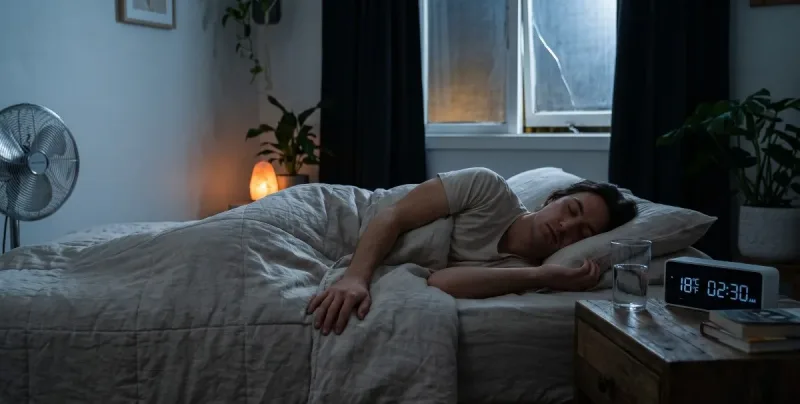
Tossing and turning, flipping your pillow to the "cool side," or kicking one leg out from under the duvet are familiar signs of thermoregulatory distress. When you cannot drift off, the root cause is frequently not in your head, but on your thermostat. Temperature is one of the most underappreciated biological drivers of sleep onset, wielding influence comparable to light and darkness.
The best bedroom temperature setting to fall asleep faster without tossing falls between 15.5°C and 19.5°C (60°F to 67°F), with 18°C (65°F) serving as the clinical sweet spot for most healthy adults. Falling asleep requires your core body temperature to drop by approximately 1°C (2°F) to initiate melatonin release and trigger the transition into slow-wave non-REM sleep. If your room is too warm, your body cannot dump excess heat, keeping your heart rate elevated and trapping you in restless light sleep.
By dialing in your thermal environment, choosing breathable bedding, and leveraging evening vasodilation, you can eliminate nighttime restlessness and fall asleep within minutes.
The Biology of Thermoregulation and Sleep Onset
Your sleep-wake cycle and internal thermostat are both regulated by the preoptic area of the hypothalamus (POAH). They operate in close biological synchronization:
-
The Circadian Temperature Drop: Your core body temperature follows a predictable 24-hour rhythm. It peaks in the late afternoon and begins dropping approximately two hours before your usual bedtime. This downward slope serves as a primary physiological signal for the pineal gland to ramp up melatonin synthesis.
-
Distal Vasodilation (Dumping Core Heat): To lower its core temperature, your body must transfer internal heat outward to the environment. It does this by dilating blood vessels in your extremities—specifically your hands, feet, and face (known as distal skin regions). When warm blood rushes to your periphery, heat radiates off the skin, dropping your internal core temperature.
-
The Problem with a Warm Room: If your bedroom ambient temperature exceeds 20°C to 22°C (68°F to 72°F), the thermal gradient between your skin and the surrounding air shrinks. Heat cannot dissipate efficiently, forcing your cardiovascular system to keep pumping faster to cool your organs. This elevates nocturnal resting heart rate and keeps your autonomic nervous system trapped in sympathetic alertness.
-
The "Too Cold" Extreme: Conversely, if your bedroom drops below 12°C to 15°C (54°F to 59°F) without adequate insulation, your body triggers vasoconstriction and involuntary shivering to defend its core temperature, which fragments sleep continuity and delays sleep onset.
The Ideal Temperature Range Breakdown
| Ambient Room Temperature | Sleep Quality Impact | Typical Physiological Response |
| Above 22°C (72°F+) | Very Poor | Suppressed deep slow-wave sleep, excessive tossing, high wakefulness, elevated sweating |
| 20°C – 22°C (68°F – 71°F) | Moderate / Borderline | Acceptable for older adults or infants, but often causes mild restlessness in average adults |
| 15.5°C – 19.5°C (60°F – 67°F) | Optimal (Clinical Sweet Spot) | Rapid sleep latency, maximized stage-3 NREM restorative sleep, stable nocturnal heart rate |
| Below 15°C (59°F) | Variable / Too Cold | Good if using thick breathable duvets; otherwise causes muscular tension and micro-arousals |
Note: For infants and toddlers, the safest recommended bedroom range is slightly higher—between 20°C and 22°C (68°F to 71°F)—as their thermoregulatory systems and metabolic surface-area-to-weight ratios are still developing.
4 Physiological Levers to Cool Your Core Faster
Setting your thermostat is only step one. You can actively manipulate your body's heat-dumping mechanics to trigger drowsiness even faster:
1. The Warm Bath Paradox (Strategic Evening Vasodilation)
Taking a warm shower or bath 90 minutes before bedtime might sound counterintuitive if the goal is cooling down, but it is one of the most reliable biohacks for rapid sleep onset.
-
How It Works: Submerging in warm water (roughly 40°C to 42°C / 104°F) brings high volumes of blood straight to the surface capillaries of your hands and feet.
-
The Thermal Crash: When you step out of the warm water into a cooler bathroom, those dilated surface vessels immediately dump heat into the surrounding air. Your internal core temperature plummets rapidly, mimicking the natural biological cascade that precedes deep sleep.
-
Optimal Timing: Complete your warm bath or shower 60 to 90 minutes before getting into bed to give the cooling curve time to reach its trough.
2. The "Warm Feet, Cool Room" Rule
One of the primary biological barriers to sleep onset is cold hands and feet (distal vasoconstriction). If your feet are cold, the blood vessels are clamped shut, meaning internal core heat cannot escape.
-
Wear Breathable Bed Socks: Putting on a pair of loose, natural-fiber socks (such as merino wool or cotton) dilates the blood vessels in your feet without overheating your legs or torso.
-
The Scientific Result: Studies demonstrate that warming the feet in a cool room accelerates distal heat dissipation, helping individuals fall asleep up to 30% faster than those going to bed with cold extremities.
3. Choose Natural, Breathable Bedding Fabrics
Synthetic bedding materials like polyester, microfiber, and nylon act like plastic wrap around your body, trapping metabolic moisture and creating a sweltering microclimate beneath the duvet.
-
Opt for 100% Long-Staple Cotton or Linen: Breathable plant fibers allow airflow and absorb moisture, preventing humidity buildup inside the bed.
-
Switch from Memory Foam to Latex or Wool: Traditional viscoelastic memory foam absorbs and retains radiant body heat throughout the night. Natural latex, hybrid innerspring mattresses, or mattress pads made of wool regulate temperature significantly better by promoting cross-ventilation.
-
Use Layered Blankets: Instead of one heavy winter duvet, use multiple lighter layers (a flat sheet plus a light cotton or wool quilt). This allows you to fine-tune your microclimate during the night without swinging between extremes.
4. Create Cross-Ventilation and Air Movement
Stagnant indoor air traps ambient humidity and exhaled heat, making a room feel warmer than the thermostat indicates.
-
Use a Low-Speed Ceiling or Desk Fan: A fan creates gentle convective air currents across your skin, speeding up natural evaporative cooling without making the room uncomfortably drafty.
-
The White Noise Bonus: The consistent, low-frequency hum of an electric fan also masks sudden ambient noises (traffic, barking dogs, creaking floors) that could cause nocturnal micro-awakenings.
-
Open an Interior Door: Keeping your bedroom door cracked open prevents carbon dioxide buildup and allows warmer air to disperse into adjoining hallways.
Common Evening Mistakes That Spike Core Temperature
Even with a cold thermostat setting, certain evening habits physically heat your body from within, undoing your sleep preparation:
-
Eating Heavy Meals Within 3 Hours of Bed: Digesting dense proteins, fats, and large carbohydrate portions induces diet-induced thermogenesis. Your gastrointestinal organs work overtime, generating internal metabolic heat that directly blocks nighttime core cooling.
-
Late-Night High-Intensity Exercise: Heavy weightlifting or intense cardiovascular training spikes your internal core temperature by 1°C to 2°C, an elevation that can take 3 to 4 hours to normalize. Complete intense workouts at least 4 hours before bedtime, reserving late evenings for gentle stretching.
-
Evening Alcohol Consumption: While alcohol acts as an initial sedative, its metabolic breakdown causes peripheral vascular dilation followed by rebound sympathetic spikes, nocturnal night sweats, and broken REM architecture in the second half of the night.
Medical Disclaimer: The information provided in this guide is for educational and informational purposes only and does not constitute medical advice or clinical diagnosis. If you suffer from chronic night sweats, persistent insomnia, thyroid imbalances, or temperature-regulation issues related to dysautonomia, consult a qualified physician or healthcare professional.




Comments
No comments yet. Be the first to ask a question or share an update.
Leave a comment
Your mobile number is never published. Comments appear after review. Website links, email addresses and code are not allowed.