
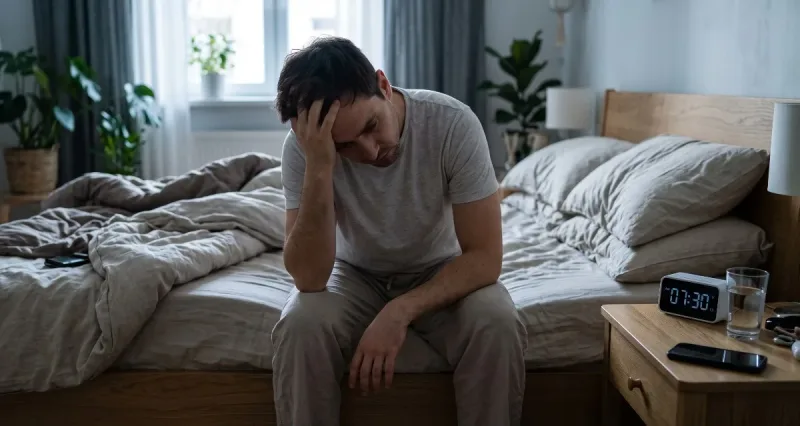
Going to bed on time, clocking eight full hours on your alarm, and still waking up feeling as though you barely slept is a deeply frustrating experience. You expect to rise refreshed, clear-headed, and energized, but instead, you are greeted by heavy limbs, mental fog, and an overwhelming desire to crawl back under the covers.
Waking up feeling exhausted after eight hours of sleep is primarily caused by poor sleep architecture, prolonged sleep inertia, nocturnal micro-arousals from airway resistance (such as sleep apnea or mouth breathing), circadian misalignment, sub-clinical nighttime dehydration, or blood sugar instability. Total sleep duration only measures time spent unconscious; true morning restoration depends entirely on the depth, continuity, and quality of your sleep cycles.
Understanding what disrupts your physiological recovery during the night allows you to look beyond the clock and target the underlying mechanisms draining your morning vitality.
1. Disrupted Sleep Architecture (Missing Out on Deep and REM Sleep)
A normal night of healthy sleep consists of four to six consecutive 90-minute ultradian cycles. Each cycle contains light sleep (N1 and N2), deep slow-wave sleep (N3), and rapid eye movement (REM) sleep.
-
The Role of Slow-Wave Sleep (N3): During deep sleep, the brain releases human growth hormone, cellular micro-tears repair, the immune system synthesizes protective cytokines, and the brain’s glymphatic system flushes away neurotoxic waste products like beta-amyloid proteins.
-
The Role of REM Sleep: This stage handles emotional processing, stress regulation, and memory consolidation.
-
The Problem: You can lie motionless in bed for eight hours while spending almost the entire duration in light stage-1 and stage-2 sleep. Substances like alcohol, late-night high-fat meals, ambient room heat, or background noise prevent the brain from dropping into restorative delta-wave sleep. You remain technically "asleep," but your brain and muscle tissues never receive the cellular repair they need.
2. Severe Sleep Inertia (Waking Up Mid-Cycle)
The grogginess you feel immediately upon waking has a clinical name: sleep inertia.
-
The 90-Minute Rhythm Trap: Sleep cycles transition from light sleep to deep sleep and back up to REM. If your alarm sounds while you are in the deepest portion of slow-wave sleep (stage N3), your brain is forced to abruptly transition from slow delta brainwaves to alert beta waves.
-
Neural Lag: Brain imaging shows that while sensory and motor regions activate within seconds of waking, the prefrontal cortex—which governs executive function, alertness, and working memory—can take 30 to 60 minutes to establish full blood flow. Waking up mid-cycle intensifies this neural lag, making you feel severely exhausted for hours.
3. Sleep-Disordered Breathing and Mouth Breathing
One of the most common yet frequently undiagnosed causes of unrefreshing eight-hour sleep is nocturnal airway resistance.
-
Obstructive Sleep Apnea (OSA) and UARS: Even if you do not loudly snore, the soft tissues at the back of your throat can partially collapse while your muscles relax. This condition, known as Upper Airway Resistance Syndrome (UARS) or mild sleep apnea, forces your brain to briefly jolt out of deep sleep into light sleep (a micro-arousal) to restore muscle tone and reopen the airway.
-
Dozens of Hidden Awakenings: These micro-arousals can happen 10 to 30 times an hour. Because they last only two to three seconds, you have no conscious memory of waking up, but your nervous system is repeatedly spiked with adrenaline and cortisol throughout the night, completely preventing sustained deep slow-wave restoration.
-
Mouth Breathing vs. Nasal Breathing: Sleeping with your mouth open causes rapid hyperventilation, expelling excessive carbon dioxide and lowering blood oxygen absorption via the Bohr effect. It also dries out oral mucosal tissues, triggers systemic inflammation, and signals low-grade emergency stress to your autonomic nervous system.
4. Sub-Clinical Nighttime Dehydration
During eight hours in bed, your body continues to lose fluids through regular respiration and trans-epidermal sweating.
-
Fluid Loss: An average adult loses roughly 500 milliliters to a full liter of water vapor overnight simply from breathing and metabolic heat dissipation.
-
Elevated Blood Viscosity: Waking up without replenishing fluids leaves you in a mildly hypovolemic state. Your blood becomes thicker, forcing your cardiovascular system to pump harder to deliver oxygen and glucose to brain cells.
-
Fatigue as a Dehydration Symptom: What many people interpret as profound morning exhaustion or lack of sleep is often simple cellular dehydration. Reaching for a strong cup of black coffee first thing only exacerbates fluid loss, as caffeine has a mild diuretic effect on an already depleted system.
5. Circadian Misalignment and Inconsistent Sleep Windows
Your body does not run on a mechanical timer; it operates on an internal circadian rhythm coordinated by the suprachiasmatic nucleus (SCN).
-
The Shifting Bedtime Penalty: Going to bed at 11:00 PM on weeknights and 2:00 AM on weekends (even if you sleep eight hours in both scenarios) creates a condition known as social jet lag.
-
Hormonal Mistiming: Your circadian clock programs daily hormone release based on predictability. It begins lowering core body temperature and elevating melatonin hours before your expected bedtime, and starts raising cortisol and blood pressure roughly two hours before your typical wake-up time.
-
The Result of Inconsistency: When your sleep window shifts erratically, your biological waking hormones fire at the wrong times. You end up waking up when your core temperature is still at its lowest circadian trough and melatonin is still actively circulating, producing profound morning exhaustion.
6. Nocturnal Hypoglycemia (Nighttime Blood Sugar Crashes)
What you eat several hours before bed dictates how stable your physiological energy remains while you rest.
-
The High-Glycemic Evening Crash: Eating refined carbohydrates, sweet desserts, or sugary drinks late in the evening causes a rapid spike in blood glucose, prompting a heavy surge of insulin.
-
Pre-Dawn Adrenaline Spikes: As insulin clears that sugar out of the bloodstream, blood glucose can plummet between 2:00 AM and 4:00 AM. In response to this acute drop (hypoglycemia), your adrenal glands release an emergency rescue dose of adrenaline and cortisol to signal the liver to release stored glycogen.
-
Fragmented Sleep: While this adrenaline burst prevents dangerous low blood sugar, it disrupts sleep quality, elevates heart rate, triggers nocturnal sweating, and causes you to wake up feeling exhausted and anxious.
7. Psychological Stress and Elevated Evening Cortisol
Chronic daytime psychological stress does not magically stop when your head hits the pillow.
-
An Overactive Sympathetic System: Prolonged emotional worry, unresolved work tasks, or late-night exposure to blue-light news feeds keeps your sympathetic nervous system ("fight-or-flight") engaged throughout the night.
-
High Sleep Heart Rate: When your nervous system remains hyper-vigilant, your resting heart rate stays elevated instead of dropping into its restorative nocturnal dip (typically a 10% to 20% drop from your daytime resting rate). Without this cardiovascular resting period, you wake up feeling as though your body ran a marathon overnight.
How to Fix Unrefreshing Eight-Hour Sleep
To transform your eight hours in bed into truly deep, restorative rest, apply these foundational lifestyle adjustments:
-
Anchor a Strict Wake-Up Time: Set a single, non-negotiable wake-up time that you adhere to seven days a week, including weekends. This locks your circadian clock into a stable rhythm, ensuring morning cortisol rises naturally right before your alarm rings.
-
Get Immediate Morning Sunlight: Step outside into natural daylight for 10 to 15 minutes within half an hour of waking. Direct sunlight suppresses residual melatonin and initiates a precise 14-hour countdown for evening sleepiness.
-
Rehydrate Before Anything Else: Place a large 500 ml glass of water next to your bed. Drink it down within ten minutes of waking, adding a tiny pinch of unrefined sea salt to restore cellular fluid and electrolyte balance.
-
Stop Eating 3 Hours Before Bed: Finish your evening meal at least three full hours before sleeping. Giving your stomach time to empty allows core body temperature to fall naturally, which is a required biological trigger for deep stage-3 sleep.
-
Tape or Check Your Airway: If you wake up with a parched mouth, a dry throat, or morning headaches, consider using gentle medical-grade mouth tape to encourage nasal breathing, or speak with a physician about a home sleep apnea test.
-
Ditch the Evening Alcohol: While a glass of wine or nightcap might help you fall asleep faster, alcohol severely fragments sleep architecture, virtually eliminating the critical second-half REM sleep periods that leave you feeling mentally refreshed.
Medical Disclaimer: The information provided in this guide is for educational and informational purposes only and does not constitute medical advice, diagnosis, or clinical care. If you suffer from chronic, unexplained morning exhaustion, loud snoring, gasping for air during sleep, or excessive daytime sleepiness, consult a qualified physician or board-certified sleep specialist for a thorough medical evaluation.




Comments
No comments yet. Be the first to ask a question or share an update.
Leave a comment
Your mobile number is never published. Comments appear after review. Website links, email addresses and code are not allowed.