
Waking up or finishing a meal only to be met with a sharp, catching pain beneath your rib cage can be alarming. When pressure builds along the lower chest wall, every deep breath feels restricted, and twisting your torso can trigger sharp twinges. Because the discomfort sits high in the abdominal cavity right near the diaphragm and chest wall, many people worry they are experiencing a pulmonary or cardiac emergency, when the real culprit is trapped gastrointestinal gas.
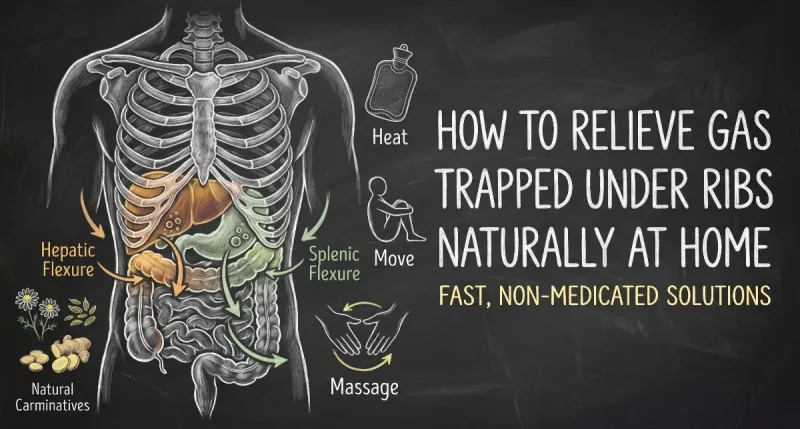
To learn how to relieve gas trapped under ribs naturally at home, you must combine mechanical decompression, targeted physical movement, and warm botanical carminatives. The most effective at-home approaches involve getting into inverted or knees-to-chest postures like the wind-relieving pose (Pawanmuktasana) to let gravity shift trapped air pockets, executing a focused clockwise abdominal massage along the large intestine's splenic and hepatic flexures, applying local heat therapy to loosen spasming smooth muscles, and sipping crushed fennel seed or ginger tea to dissolve gas bubbles.
Understanding why gas becomes stuck in the highest turns of the colon empowers you to release the pocket quickly and prevent it from recurring. Below is an exhaustive, non-medicated, step-by-step guide designed to help you decompress your rib cage safely and restore digestive ease from the comfort of home.
Why Gas Gets Trapped Under the Ribs: The Anatomy of Flexure Syndromes
The sensation of trapped gas beneath the ribs is primarily anatomical. Your large intestine does not run in a loose circle; it forms an inverted U-shape within the abdomen with two distinct, sharp corners located high up directly underneath the rib cage:
-
The Splenic Flexure (Upper Left Rib): This is the bend where the transverse colon turns downward into the descending colon. It rests right beneath the left diaphragm and spleen, positioned directly under the lower ribs and inches below the heart. When gas pools here, the condition is clinically referred to as Splenic Flexure Syndrome.
-
The Hepatic Flexure (Upper Right Rib): This is the turn where the ascending colon transitions into the transverse colon. It is tucked underneath the liver on the right side of your rib cage.
Because digestive gas naturally rises like air bubbles in water, pockets of swallowed air and bacterial fermentation gas float to the highest anatomical points in your digestive tract: the splenic and hepatic flexures.
If peristalsis slows down, if tight clothing compresses the midsection, or if stool delays transit in the descending colon, these gas pockets become trapped at these sharp bends. The expanding air bubble stretches the sensitive visceral nerve endings in the intestinal lining and presses upward against the diaphragm. This upward pressure refers pain directly into the ribs, upper back, and lower chest wall.
4 Postures and Stretches to Free Trapped Rib Gas Immediately
When gas is wedged into the upper corners of the colon, sitting upright or slouching on a couch locks it in place. You must use physical positioning and gravity to widen the angles of your colonic flexures, allowing the trapped bubble to move downward toward the rectum for release.
1. The Wind-Relieving Pose (Pawanmuktasana)
This classic yoga posture provides gentle mechanical compression against the ascending and descending colonic tracts, prompting trapped air to move around stubborn turns.
-
Lie completely flat on your back on a yoga mat, carpet, or firm mattress.
-
Inhale deeply, bend both knees, and bring them upward toward your chest.
-
Wrap your arms around your shins or clasp your hands behind your thighs to pull your knees snug against your torso.
-
Keep your head and neck resting flat on the floor to maintain an open airway.
-
Hold this position for 60 to 90 seconds while taking slow, deep diaphragmatic breaths into your lower belly.
-
Slowly rock your torso from side to side to gently massage the abdominal organs against the floor. This rocking motion encourages gas trapped under the splenic bend to move downward.
2. Child’s Pose with Wide Knees (Balasana)
Child's pose lengthens the torso, decompresses the diaphragm, and lowers internal abdominal pressure, allowing the upper colon to expand and release trapped bubbles.
-
Kneel on a soft surface, bringing your big toes together while spreading your knees roughly hip-width or wider.
-
Hinge at your hips and lower your chest forward between your knees.
-
Extend your arms straight out ahead of you on the floor, resting your forehead gently on the mat.
-
Breathe slowly into your back and lower ribs for 2 to 3 minutes.
-
As your torso relaxes between your thighs, the diaphragm ascends, creating space that allows gas trapped beneath the rib margins to shift forward and exit.
3. The Puppy Pose (Uttana Shishosana)
This inverted posture places your hips higher than your chest, using gravity to pull stubborn gas out of deep pelvic and diaphragmatic pockets.
-
Start on your hands and knees in a tabletop position, with your hips aligned directly above your knees.
-
Keeping your hips elevated directly over your knees, walk your hands forward along the floor.
-
Lower your chest toward the floor, allowing your back to arch gently and your chin or forehead to rest on the mat.
-
Take 5 to 8 slow, deep breaths in this position. The elevation of your hips allows gas trapped at the splenic flexure to rise away from the diaphragm and find an unobstructed path toward the lower bowel.
4. Seated Torso Twist (Ardha Matsyendrasana Variation)
Rotational stretches gently twist and decompress the transverse colon, helping squeeze gas bubbles through the hepatic and splenic corners.
-
Sit upright on a firm chair with your feet flat on the floor, or sit cross-legged on a mat.
-
Inhale deeply and lengthen your spine upward toward the ceiling.
-
As you exhale, gently rotate your torso to the left, placing your right hand on your outer left knee and your left hand on the chair or floor behind you.
-
Hold the stretch for 15 to 20 seconds, maintaining slow, steady breathing, then gently unwind back to center.
-
Repeat the movement on the right side. Perform 3 gentle sets per side.
Targeted Abdominal Massage: The "I Love You" (ILU) Technique
Physical external massage is one of the most effective mechanical methods to break up dense pockets of air and nudge them along the natural route of the large intestine.
-
Preparation: Lie on your back with a pillow under your knees to ensure your abdominal muscles remain completely slack and soft. You can apply a few drops of warm jojoba, olive, or almond oil to your hands to reduce skin friction.
-
Step 1 (The "I" Stroke): Place two fingers on the upper left side of your abdomen, directly below the left rib cage. Gently but firmly sweep downward in a straight line toward your left hip bone. Repeat this stroke 10 times to clear out the descending colon and create an open path for new gas to travel down.
-
Step 2 (The "L" Stroke): Place your fingers under your right rib cage (near the hepatic flexure). Sweep straight across the upper abdomen beneath your ribs to the left side, then turn and sweep down to the left hip bone (forming an inverted "L"). Repeat this movement 10 times to guide air across the transverse colon.
-
Step 3 (The "U" Stroke): Start at the lower right corner of your abdomen near your right hip bone. Sweep upward along the right flank to the right ribs, across the upper abdomen to the left ribs, and down the left flank toward the pelvis (forming an inverted "U"). Repeat this full clockwise loop 10 to 15 times.
Always move strictly in a clockwise direction. Massaging counter-clockwise pushes gas and stool backward against your natural digestive flow, which can worsen cramping.
3 Fast-Acting Herbal Carminatives to Break Up Gas Bubbles
Herbal infusions contain volatile essential oils that act as natural carminatives—agents that prevent the formation of gas and actively facilitate its expulsion by reducing surface tension on fluid bubbles.
1. Crushed Fennel Seed Tea
Fennel seeds (Foeniculum vulgare) are widely recognized as one of nature’s most effective carminatives for acute gas entrapment.
-
Why It Works: Fennel seeds are rich in anethole, a volatile compound that relaxes intestinal smooth muscle and causes trapped, microscopic gas bubbles to fuse into larger pockets that pass effortlessly.
-
How to Brew: Place 1 teaspoon of whole fennel seeds on a cutting board and crush them gently with the back of a spoon to crack the outer shell and release the aromatic oils. Steep the crushed seeds in 250 ml of boiling water for 10 minutes. Always cover the cup with a saucer while steeping to prevent the medicinal volatile oils from evaporating with the steam. Sip slowly while warm.
2. Freshly Grated Ginger Root Tea
Ginger (Zingiber officinale) is a powerful prokinetic agent, meaning it stimulates natural digestive contractions and keeps food and gas moving downward.
-
Why It Works: Bioactive gingerols and shogaols accelerate gastric emptying. If gas is trapped under the ribs due to sluggish stomach clearance, ginger stimulates the pyloric valve to open, allowing upper digestive contents to move smoothly into the small intestine.
-
How to Brew: Grate one inch of fresh, peeled ginger root into a small pot containing two cups of water. Bring to a gentle boil, then simmer on low for 8 to 10 minutes. Strain into a mug, let cool until pleasantly warm, and sip.
3. German Chamomile Tea
When gas cramps are worsened by nervous stress or shallow breathing, chamomile acts as a dual-action muscle relaxant and mild sedative.
-
Why It Works: Chamomile contains bisabolol and apigenin, compounds that bind to smooth muscle receptors in the digestive tract to quell painful spasms while calming the gut-brain axis.
-
How to Brew: Steep 2 tablespoons of dried chamomile flowers or two quality tea bags in 250 ml of hot water for 8 minutes, covered. Drink slowly while resting in an upright, supported position.
Immediate At-Home Habits to Relieve Pressure
-
Apply a Warm Heating Pad: Place an electric heating pad or warm water bottle directly across your upper abdomen and lower rib margins for 15 to 20 minutes. Heat triggers localized vasodilation, increasing blood flow to spasming smooth muscle tissue and dulling visceral pain signals via thermal cutaneous nerve pathways.
-
Drink a Glass of Warm Water: Cold fluids cause the smooth muscle of the digestive tract to seize and spasm. A glass of lukewarm water gently relaxes the stomach walls, stimulates the gastrocolic reflex, and encourages trapped bubbles to move.
-
Take a Slow, Upright Stroll: Avoid lying completely flat on a couch or curling up into a tight ball, as compressing your waistline traps gas further. Walking upright at an easy pace around your living room encourages natural digestive peristalsis and allows gravity to assist in moving trapped air pockets.
-
Loosen Tight Waistbands: Belts, high-waisted leggings, and tight waistbands exert constant external pressure on the transverse colon, pinning gas pockets directly beneath the ribs. Change into loose, non-restrictive clothing immediately.
When Trapped Rib Gas Requires Emergency Medical Care
Because the ribs sit directly over vital thoracic organs, you must ensure that chest or upper abdominal pain is not a life-threatening cardiopulmonary emergency. Never write off severe thoracic pain as "just gas" if red-flag symptoms are present.
Seek immediate emergency medical attention if your rib or chest pain is accompanied by:
-
Crushing, squeezing, heavy, or aching pressure in the center of your chest that radiates into your left shoulder, arm, neck, jaw, or back.
-
Sudden, unexplained shortness of breath, gasping, or difficulty taking in a full breath while resting.
-
Cold, clammy sweats, sudden pallor, or unexplained dizziness, lightheadedness, and fainting.
-
Severe, localized pain in the upper right rib area that radiates straight through to the right shoulder blade, accompanied by fever or nausea (indicative of acute cholecystitis or gallstones).
-
Vomiting blood, coughing up blood, or passing dark, tarry stools.
-
Pain that steadily worsens during physical exertion (such as walking up stairs) and does not improve when you pass gas or burp.
Medical Disclaimer: The information provided in this guide is designed strictly for educational and informational purposes and does not constitute formal medical advice, clinical diagnosis, or treatment. If you experience severe, unfamiliar, or persistent chest, rib, or abdominal pain, always consult a qualified physician or seek emergency medical evaluation immediately.



Comments
No comments yet. Be the first to ask a question or share an update.
Leave a comment
Your mobile number is never published. Comments appear after review. Website links, email addresses and code are not allowed.