
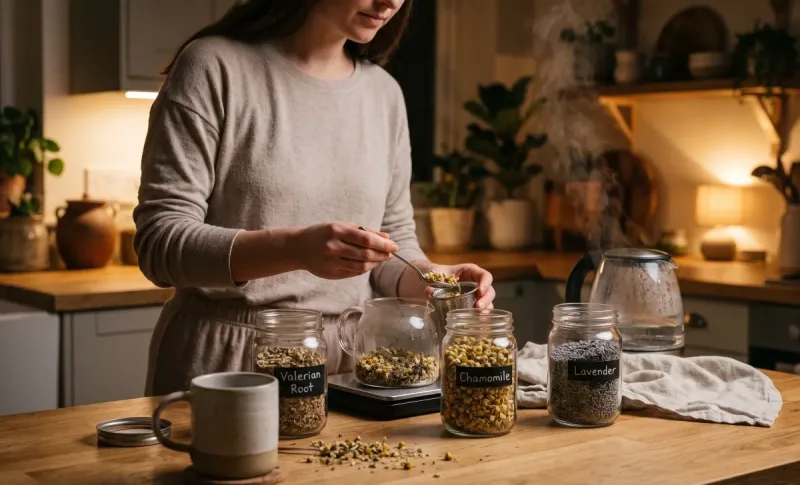
Waking up feeling unrefreshed, irritable, or mentally fatigued is often not a question of how many hours you slept, but how much time you spent in restorative sleep stages. Rapid Eye Movement (REM) sleep and Slow-Wave Sleep (deep NREM stage 3) form the core of nighttime recovery. While deep slow-wave sleep repairs physical muscle tissues and clears cellular metabolic waste, REM sleep is where the brain consolidates emotional memories, processes cognitive stress, and synthesizes complex problem-solving abilities.
The most effective herbal tea blends that help induce deep restorative REM sleep combine synergistic botanicals rich in apigenin, valerenic acid, rosmarinic acid, and chrysin. Blending nervine herbs like chamomile, valerian root, passionflower, lemon balm, and holy basil naturally boosts gamma-aminobutyric acid (GABA) signaling in the brain, lowers evening core body temperature, and calms central nervous system arousal without disrupting natural sleep architecture.
Unlike pharmaceutical sedatives and synthetic sleep aids that artificially induce unconsciousness while suppressing natural REM dream states, plant-based infusions support your body’s built-in neurochemistry to facilitate uninterrupted, high-quality sleep cycles.
Understanding Deep Sleep vs. REM Sleep Architecture
A normal night of sleep consists of repeating 90-minute ultradian cycles divided between non-rapid eye movement (NREM) and rapid eye movement (REM) stages:
-
Stage 1 & 2 (Light Sleep): Your body temperature drops, muscles relax, and heart rate slows. Brainwaves shift from daytime beta and alpha frequencies into slower theta rhythms punctuated by sleep spindles.
-
Stage 3 (Deep Slow-Wave Sleep): Brain activity slows dramatically into high-amplitude delta waves. Growth hormone is secreted, cellular tissues repair, the immune system synthesizes cytokines, and the brain's glymphatic system flushes away metabolic debris such as beta-amyloid proteins.
-
Stage 4 (REM Sleep): Often called paradoxical sleep, REM is characterized by rapid eye movements, temporary muscular paralysis (atonia), and high-frequency brain activity resembling wakefulness. This stage is responsible for vivid dreaming, neuroplasticity, memory consolidation, and psychological equilibrium.
-
The Sedative Paradox: Many pharmaceutical sleep medications and alcohol act as broad-spectrum central nervous system depressants. While they cause drowsiness, they significantly suppress natural REM sleep duration, leaving you mentally foggy and emotionally fragile the next day. High-grade herbal tea blends, by contrast, modulate neuroreceptors gently, preserving normal sleep-stage cycling.
Key Active Compounds in Sleep Botanicals
Herbs do not work through placebo alone; their therapeutic effects stem from bioavailable phytochemicals that interact directly with neurotransmitter systems:
-
Apigenin: A natural bioactive flavonoid found abundantly in chamomile. Apigenin crosses the blood-brain barrier and binds selectively to benzodiazepine receptors on the $GABA_A$ complex, creating mild anxiolytic and muscle-relaxing effects without chemical dependency.
-
Valerenic Acid and Isovaleric Acid: Powerful sesquiterpenoids found in valerian root. They inhibit enzymes that break down gamma-aminobutyric acid (GABA), allowing higher concentrations of this inhibitory neurotransmitter to remain active in synapses to quiet mental chatter.
-
Rosmarinic Acid: A natural polyphenol concentrated in lemon balm. It inhibits GABA transaminase (GABA-T), preserving neurochemical calm and reducing somatic restlessness.
-
Chrysin and Harmala Alkaloids: Active compounds in passionflower that regulate the monoamine system, ease emotional tension, and prevent midnight awakenings.
4 Synergistic Herbal Tea Blends for Deep REM Sleep
Blending complementary herbs creates an entourage effect, where each ingredient enhances the bio-absorption and therapeutic strength of the others.
1. The Classic Calming Blend (Chamomile + Lavender + Lemon Balm)
This gentle, highly aromatic infusion is ideal for those whose sleep is disrupted by mild cognitive worry, restlessness, or physical tension at the end of a busy workday.
-
Chamomile (Matricaria chamomilla): Supplies apigenin to quiet overactive neural circuits and soothe smooth muscle tissue along the digestive tract.
-
Lavender Buds (Lavandula angustifolia): Rich in linalool and linalyl acetate, which reduce autonomic sympathetic nervous system tone simply through inhalation during sipping.
-
Lemon Balm (Melissa officinalis): Boosts brain GABA levels and provides a light citrus flavor that offsets floral undertones.
-
How to Brew: Combine 1 tablespoon of whole dried chamomile flowers, 1 teaspoon of dried lemon balm leaves, and 1/2 teaspoon of culinary-grade dried lavender buds in 250 ml of freshly boiled water (90°C to 95°C). Cover tightly with a lid and steep for 8 to 10 minutes to prevent volatile aromatic oils from evaporating.
2. The Heavy-Duty Neurological Reset (Valerian Root + Passionflower + Skullcap)
This earthy, pungent blend is designed for chronic night-owls, high-stress periods, or individuals struggling with persistent midnight awakenings and fragmented REM cycles.
-
Valerian Root (Valeriana officinalis): Acts as a primary botanical sleep inducer by boosting synaptic GABA availability and shortening sleep latency (the time it takes to drift off).
-
Passionflower (Passiflora incarnata): Clinical trials indicate passionflower significantly improves subjective sleep quality and prolongs uninterrupted REM periods without morning grogginess.
-
American Skullcap (Scutellaria lateriflora): A premier nervine tonic that relieves muscular twitches, restless leg sensations, and nervous exhaustion.
-
How to Brew: Because valerian consists of dense woody roots, combine 1 teaspoon of cut valerian root, 1 teaspoon of dried passionflower leaves, and 1 teaspoon of skullcap in a small saucepan with 300 ml of cold water. Bring to a gentle simmer, cover, and let it decoct on low heat for 12 to 15 minutes. Strain thoroughly. Add a slice of fresh orange peel or a teaspoon of raw honey to balance the strong, pungent flavor.
3. The Emotional & Cortisol Balancing Blend (Ashwagandha Root + Holy Basil + Spearmint)
If your sleep issues stem from elevated evening stress hormones, racing heartbeats, or emotional burnout, an adaptogenic blend provides systemic equilibrium.
-
Ashwagandha (Withania somnifera): Its Latin name (somnifera) literally translates to "sleep-inducing." It contains withanolides that normalize the hypothalamic-pituitary-adrenal (HPA) axis, systematically lowering elevated evening cortisol.
-
Holy Basil / Tulsi (Ocimum sanctum): Protects neurological pathways from oxidative stress, balances blood glucose levels overnight, and prevents cortisol-driven 3:00 AM awakenings.
-
Spearmint (Mentha spicata): Adds a refreshing, smooth note while relaxing abdominal muscles and easing evening indigestion.
-
How to Brew: Simmer 1 teaspoon of dried ashwagandha root powder or slices with 1 teaspoon of dried holy basil leaves and a few fresh spearmint leaves in 250 ml of water for 10 minutes. Strain and enjoy warm.
4. The Floral Neuromuscular Release (Linden Flower + California Poppy + Oat Straw)
This blend is tailored for individuals who carry physical stress in their jaw, neck, and shoulders, or who experience physical restlessness in bed.
-
Linden Flower (Tilia cordata): Known for mild antispasmodic and diaphoretic properties that gently release muscular cramping and promote peripheral blood flow.
-
California Poppy (Eschscholzia californica): Contains protopine and allocryptopine, which gently bind to opioid and GABA receptors, softening physical discomfort and inducing deep somatic relaxation.
-
Milky Oat Straw (Avena sativa): Packed with bioavailable silica, magnesium, and B-complex vitamins that nourish frayed nerve fibers over long-term use.
-
How to Brew: Steep equal parts (1 teaspoon each) of linden flower, California poppy herb, and oat straw in 300 ml of hot water for 12 minutes under a covered mug.
Best Practices for Brewing and Timing Your Sleep Teas
To extract the maximum therapeutic value from botanical blends, preparation details matter:
-
Always Cover While Steeping: The active anxiolytic terpenes and essential oils in chamomile, lavender, and lemon balm are highly volatile. Leaving your cup uncovered while steeping allows these beneficial airborne compounds to escape into the room. Keep a small saucer or lid placed over your mug.
-
The 60-to-90-Minute Drinking Window: Finish your herbal infusion approximately 60 to 90 minutes before your planned bedtime. Drinking a large volume of liquid immediately before lying down causes nocturia (waking up in the middle of the night to urinate), which interrupts valuable REM sleep cycles in the second half of the night.
-
Leverage the Thermal Drop: Drinking a warm herbal tea causes mild peripheral vasodilation: warm blood moves toward your hands, feet, and skin surface. As that heat radiates into the evening air, your core body temperature drops by roughly 1°C, providing the biological signal needed for deep sleep onset.
-
Cycle Your Heavy Blends: While gentle herbs like chamomile and lemon balm can be enjoyed indefinitely, potent roots like valerian are best used in cycles—such as three to four weeks on, followed by one week off—to maintain receptor sensitivity and prevent adaptation.
Potential Contraindications and Safety Precautions
Natural botanicals contain potent biochemical properties and should be used mindfully:
-
Medication Interactions: If you take prescription sedatives, anti-anxiety medications (such as benzodiazepines or SSRIs), or blood pressure drugs, consult your doctor before using valerian, skullcap, or passionflower, as they can compound sedative effects.
-
Pregnancy and Breastfeeding: Certain herbs, notably passionflower, ashwagandha, and California poppy, can stimulate uterine contractions and should be avoided during pregnancy unless specifically approved by an obstetrician.
-
Allergies: Individuals allergic to plants in the Asteraceae/Compositae family (such as ragweed, daisies, or marigolds) may occasionally experience allergic reactions to chamomile.
Medical Disclaimer: The information provided in this guide is for educational and informational purposes only and does not constitute medical advice, diagnosis, or clinical therapy. If you suffer from chronic insomnia, severe sleep apnea, or underlying psychological disorders, seek personalized guidance from a qualified physician or healthcare professional.




Comments
No comments yet. Be the first to ask a question or share an update.
Leave a comment
Your mobile number is never published. Comments appear after review. Website links, email addresses and code are not allowed.