
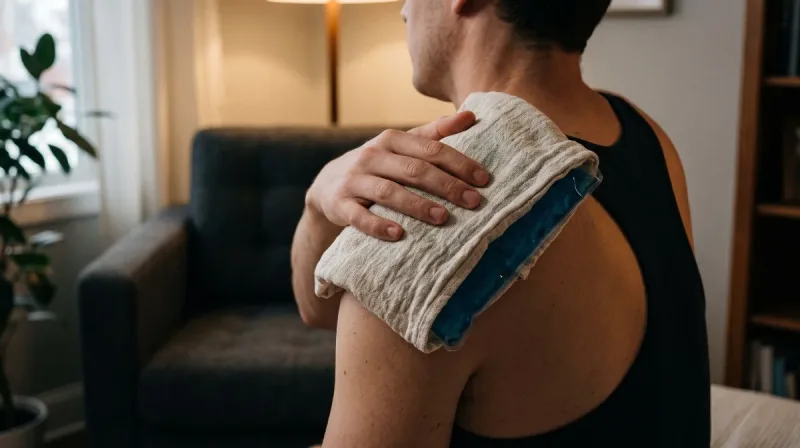
A sudden twinge or sharp pull beneath your shoulder blade can instantly disrupt your day. Whether it happened mid-deadlift, after reaching awkwardly into the back seat of your car, or while lifting a heavy box, an acute muscular strain in this area creates immediate stiffness, localized aching, and sharp pain during movement.
When that pain strikes, the natural instinct is to reach into the freezer or turn on a heating pad. However, reaching for the wrong temperature modality during the initial phase of injury can prolong recovery, aggravate swelling, or worsen tissue inflammation.
Understanding the physiological debate—ice vs heat pack for acute pulled muscle in lower shoulder—ensures you make the right choice from minute one, accelerating tissue repair and restoring pain-free mobility.
Anatomy of the Lower Shoulder: What Did You Actually Pull?
The "lower shoulder" is an intricate anatomical junction where the shoulder girdle meets the thoracic spine and posterior rib cage. Because this area transfers load between the upper body, core, and neck, multiple overlapping muscle layers are susceptible to acute strains.
-
Infraspinatus and Teres Minor: These lower rotator cuff muscles sit over the back of the shoulder blade (scapula), providing external rotation and stabilizing the shoulder joint in its socket.
-
Rhomboid Major and Minor: Running diagonally from the spine to the medial border of the scapula, these retract and anchor your shoulder blade. Strains here often feel like a stabbing knot medial to the shoulder blade.
-
Latissimus Dorsi ("Lats"): A broad muscular sheet originating along the thoracic/lumbar spine and pelvis, inserting into the upper arm bone (humerus). A pull in its upper fibers presents as lower-to-mid shoulder tension.
-
Lower Fibers of the Trapezius: Responsible for depressing and stabilizing the scapula during overhead reaches and posture maintenance.
When an acute pull occurs, structural muscle fibers and surrounding microvasculature undergo microscopic tearing. The body responds with an immediate inflammatory cascade: blood vessels dilate, inflammatory mediators flood the site, fluid pools (edema), and local nerve endings become hypersensitive.
The Verdict: Ice vs Heat Pack for an Acute Pulled Muscle
For an acute muscle strain—meaning an injury that occurred within the last 0 to 72 hours—ice is the definitive clinical choice.
Applying heat to an acute lower shoulder strain during this active inflammatory window is one of the most common rehabilitation mistakes. Heat causes vasodilation (widening of blood vessels), increasing blood flow and fluid accumulation to already engorged, micro-torn tissues. This often amplifies internal pressure, worsens swelling, and increases pain.
Comparing Both Modalities
-
Primary Vascular Effect: Cold therapy causes vasoconstriction (narrowing of blood vessels) to limit fluid pooling, whereas heat causes vasodilation (widening of vessels) which increases circulation.
-
Tissue and Cellular Response: Ice lowers local metabolic demand and cellular oxygen consumption to protect borderline cells from dying. Heat accelerates metabolic activity and cellular oxygenation to feed rebuilding tissue.
-
Inflammatory Action: Ice controls acute swelling, edema, and excessive inflammatory fluid leakage. Heat encourages fluid inflow, which can spike swelling if used prematurely.
-
Pain Relief Mechanism: Ice blunts the firing rate of local pain nerves (nociceptors) for a numbing, analgesic effect. Heat stimulates thermal receptors that override dull, aching tension and relaxes hypertonic tissue.
-
Optimal Timing: Ice belongs strictly in the acute phase (0 to 72 hours). Heat is best suited for the subacute and chronic remodeling phases (Day 4 onward).
-
Potential Misuse Risk: Ice applied directly to bare skin can cause frostbite or tissue irritation. Heat used on a fresh acute injury can aggravate inflammation, expand fluid pooling, and trigger sharp throbbing.
The Physiology of Cold Therapy: Why Ice Wins in the Acute Phase
Cryotherapy operates through several distinct physiological mechanisms that directly address acute tissue trauma.
1. Vasoconstriction and Edema Control
Upon contact with cold, local vascular smooth muscle contracts. This reduction in vessel diameter curbs microvascular permeability, slowing the rush of plasma and white blood cells into the extracellular space. Controlling this fluid buildup avoids excessive compartmental pressure beneath the scapula.
2. Metabolic Suppression
Injured muscle cells suffer reduced oxygen delivery due to torn micro-capillaries. Surrounding healthy cells risk secondary hypoxic injury (cellular death caused by lack of oxygen in the swollen zone). Cold lowers the baseline metabolic demand and enzymatic consumption of nearby muscle fibers, preserving intact tissue until circulation stabilizes.
3. Pain Reduction (Analgesia)
Cold reduces sensory nerve conduction velocity. By blunting the firing frequency of peripheral nociceptors (pain receptors) around the lower shoulder, cold application acts as a temporary, localized anesthetic without pharmacological side effects.
4. Muscle Spasm Interruption
When a muscle pulls, the central nervous system often initiates an involuntary, continuous contraction known as a "protective muscle spasm" to splint the region. Cryotherapy reduces muscle spindle sensitivity, dialing back hypertonic spasm activity so the lower shoulder stops locking up.
Step-by-Step Guide: How to Ice a Lower Shoulder Strain
Applying ice improperly can lead to skin irritation or superficial nerve freezing. To ice effectively, follow a structured sequence.
-
Protect the Skin Barrier: Never apply raw ice, chemical gel packs, or frozen items directly to bare skin. Wrap the cold pack in a clean, damp cotton dish towel. Moisture conducts cold more efficiently than a dry barrier while shielding skin layers.
-
Target the Muscle: The lower shoulder is contoured by the scapula and rib cage. Sit upright or lie on your opposite side. Place the ice pack over the specific point of maximal tenderness (such as between the lower blade edge and spine).
-
Secure with Gentle Compression: Use an elastic bandage or lean gently back against an armchair or pillow to keep the pack snug against the tissue contour without forcing painful pressure onto the joint.
-
Time the Application: Ice for 15 to 20 minutes per session. Stop immediately if the area becomes completely numb. Applying cold for longer than 20 minutes can trigger a reflex rebound vasodilation (the hunting reaction), which reverses the anti-inflammatory benefit.
-
Observe Rest Intervals: Allow skin and muscle temperature to return entirely to normal before re-applying—wait at least 45 to 60 minutes between icing bouts. Repeat 3 to 5 times daily throughout the first 48 to 72 hours.
When Does Heat Become Beneficial?
Heat is not the enemy; timing dictates its value. Once the acute inflammatory phase transitions into the subacute remodeling phase (typically 72 to 96 hours post-injury), thermotherapy becomes an essential therapeutic tool.
Benefits of Heat in the Subacute Phase:
-
Tissue Elasticity: Heat alters collagen viscosity, allowing stiff, guarding lower shoulder tendons and muscle fibers to stretch smoothly without pulling at new scar tissue.
-
Nutrient and Oxygen Influx: Vasodilation brings fresh arterial blood, cellular nutrients, amino acids, and oxygen required for collagen synthesis and tissue remodeling.
-
Waste Clearance: Accelerated venous return sweeps away metabolic debris and dormant inflammatory byproducts left over from the initial injury.
-
Sedative Neurological Effect: Warmth stimulates cutaneous thermoreceptors (G-fibers), which down-regulate pain transmission at the spinal cord level via the gate control theory of pain.
How to Apply Heat After 72 Hours:
Use moist heat—such as a warm damp towel, moist heating pack, or warm shower stream—for 15 to 20 minutes. Moist heat penetrates deeper into the thick musculature of the shoulder blade than dry electric pads. Keep the heat setting moderate; the sensation should be soothing, never burning.
The Modern Recovery Protocol: Moving Past R.I.C.E. to P.E.A.C.E. & L.O.V.E.
For decades, sports medicine relied on the R.I.C.E. (Rest, Ice, Compression, Elevation) formula. Contemporary soft-tissue clinical consensus has evolved toward the evidence-based P.E.A.C.E. & L.O.V.E. protocol (popularized by the British Journal of Sports Medicine).
Immediately After the Injury: P.E.A.C.E.
-
P – Protect: Unload the lower shoulder for the first 24 to 48 hours. Minimize heavy lifting, carrying groceries on that side, or aggressive movements.
-
E – Elevate: Difficult for the shoulder, but avoid slumped postures that drop the shoulder girdle and place tension on posterior fibers.
-
A – Avoid Anti-Inflammatory Modalities in Excess: While short-term ice is recommended for pain control and excessive edema, prolonged suppression of the body's natural healing cascade with high-dose NSAIDs (e.g., ibuprofen) can delay cellular regeneration.
-
C – Compress: A soft posture wrap or kinesiology tape can provide proprioceptive support to the scapula.
-
E – Educate: Understand that soft tissue requires progressive movement, not complete prolonged bed rest, to heal properly.
As Pain Settles: L.O.V.E.
-
L – Load: As acute pain decreases, introduce gentle, active mechanical loading without aggravating sharp pain.
-
O – Optimism: Psychological state directly impacts autonomic tone and central pain perception.
-
V – Vascularization: Low-impact cardiovascular activity (like brisk walking or gentle stationary cycling) drives systematic blood circulation to promote recovery.
-
E – Exercise: Gradually reintroduce scapular retraction, protraction, and controlled external rotation to align newly formed collagen fibers along functional lines of stress.
Early Movement and Gentle Rehabilitation Exercises
Once the 72-hour acute window passes and cold therapy has controlled swelling, prolonged immobilization becomes counterproductive. Resting a strained muscle for too long creates dense, disorganized scar tissue, reduces neuromuscular control, and leads to adhesive stiffness.
Begin these three gentle mobility exercises only after acute, sharp pain has subsided into a dull, manageable ache.
1. The Pendulum Swing
Lean forward with your uninjured arm supported on a sturdy table. Let your injured arm hang loosely toward the floor like a ragdoll.
-
Gently sway your torso to initiate circular momentum—let the weight of the arm create the circle rather than using shoulder muscles.
-
Complete 10 clockwise and 10 counterclockwise circles.
-
Goal: Decompresses the glenohumeral joint and activates low-threshold stabilizing fibers with minimal strain.
2. Scapular Squeezes (Retraction)
Sit tall in an upright chair with your arms relaxed at your sides and elbows bent to 90 degrees.
-
Slowly draw your shoulder blades back and down, imagining you are pinching a pencil between your lower shoulder blades.
-
Hold for 3 to 5 seconds, breathing steadily, then release slowly.
-
Perform 2 sets of 8 to 10 repetitions.
-
Goal: Re-engages the rhomboids and lower trapezius without putting them under high mechanical load.
3. Doorway Pectoral Stretch
A tight chest pulls the shoulder forward, placing constant strain on healing posterior muscles.
-
Stand in an open doorway. Place your forearm against the door jamb with your elbow slightly below shoulder height.
-
Step gently forward with one foot until you feel a comfortable stretch across the front of your chest.
-
Hold steadily for 20 to 30 seconds without bouncing.
-
Repeat 2 to 3 times per side.
-
Goal: Opens the anterior chest to remove compensatory strain from the lower posterior shoulder.
When to See a Doctor
While most lower shoulder strains resolve over 2 to 4 weeks with home therapy, some symptoms suggest structural damage beyond a simple grade-1 muscle pull. Seek a medical evaluation if you encounter:
-
Radicular Symptoms: Numbness, tingling, or an "electric shock" sensation traveling down your arm into your fingers (suggestive of cervical nerve root irritation rather than a localized muscle pull).
-
Visible Deformity or Sudden Weakness: Inability to lift your arm out to the side or touch the back of your head.
-
Severe Night Pain: Constant, throbbing pain that wakes you from sleep regardless of positioning.
-
Systemic Symptoms: Fevers, unexplained chills, or shortness of breath (sudden back/shoulder blade pain accompanied by chest pressure requires emergency medical care to rule out cardiopulmonary events).
-
Lack of Progress: Pain that remains unchanged or worsens after 7 to 10 days of consistent rest and temperature therapy.
Medical Disclaimer: The information provided here is for educational purposes only and does not substitute for professional medical advice, diagnosis, or treatment. Always consult a qualified healthcare provider regarding any musculoskeletal injury. If you experience severe chest tightness, shortness of breath, or numbness radiating down your arm, seek emergency medical care immediately.



Comments
No comments yet. Be the first to ask a question or share an update.
Leave a comment
Your mobile number is never published. Comments appear after review. Website links, email addresses and code are not allowed.