
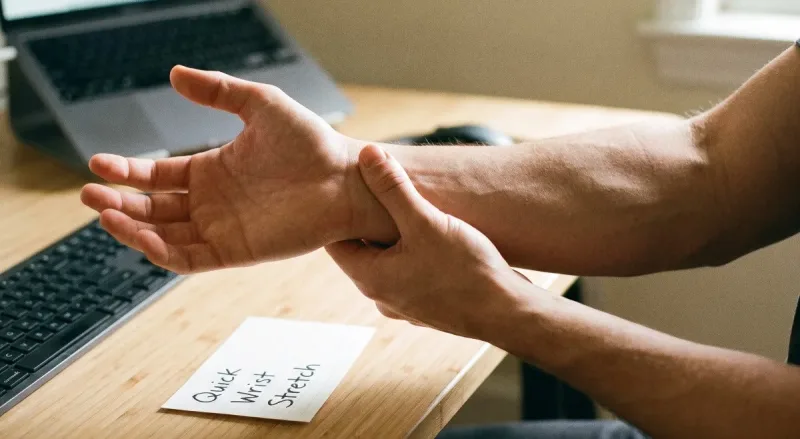
Hours spent clacking on a mechanical keyboard, typing on a laptop, or maneuvering a mouse subject the delicate structures of your hands and wrists to thousands of repetitive micro-movements. Over time, prolonged static positioning, sustained forearm pronation, and constant finger flexion restrict local blood flow and create micro-friction along synovial tendon sheaths.
Learning quick ergonomic wrist exercises to prevent typing wrist fatigue helps you lubricate the carpal tunnel, mobilize compressed peripheral nerves, ease muscular tension in your forearm flexors and extensors, and stop repetitive strain injury (RSI) before it develops into chronic dysfunction.
Below is an evidence-based daily desktop guide explaining the biomechanics of keyboard fatigue, a quick 4-step desk mobility routine, targeted tendon glides, ergonomic desk configurations, and answers to common questions.
The Biomechanics: Why Typing Causes Wrist Fatigue
The human hand contains no muscles capable of producing strong finger flexion; instead, the powerful muscle bellies that close and open your fingers reside in your forearm.
When you type:
-
Repetitive Tendon Excursion: Long tendons (flexor digitorum superficialis and profundus) glide back and forth through the carpal tunnel—a rigid, narrow fibro-osseous canal on the palm side of the wrist bounded by the carpal bones and the transverse carpal ligament.
-
Wrist Extension & Contact Pressure: Typing with your wrists bent backward (wrist extension) or resting heavily on the edge of a desk increases hydrostatic pressure inside the carpal tunnel, compressing the median nerve and local micro-capillaries.
-
Forearm Pronation & Tendon Friction: Keeping your palms flat against the desk requires full forearm pronation. This twists the radius and ulna bones, causing the extensor muscles on the top of the forearm to stay in a state of continuous low-grade static contraction (ischemia), leading to the familiar ache, tightness, and heavy feeling in your forearms and wrists.
The 3-Minute Desk Reset: 4 Quick Ergonomic Exercises
Take a micro-break every 45 to 60 minutes to perform these fluid, low-load exercises right at your workstation.
1. The Dynamic Prayer-to-Reverse Stretch
Target: Stretches both forearm flexors and extensors to decompress the anterior wrist.
-
How to Perform:
-
Sit tall with your shoulders relaxed.
-
Bring your palms together in front of your chest in a prayer position, with your elbows bent and pointing out to the sides.
-
Keeping your palms pressed firmly together, slowly lower your hands toward your waistline until you feel a gentle, comfortable stretch along your inner wrists and forearms.
-
Hold for 10 to 15 seconds while breathing smoothly.
-
Next, flip the movement: place the backs of your hands together with your fingers pointing down toward the floor. Gently raise your elbows to stretch the tops of your wrists and forearm extensors.
-
Hold for 10 to 15 seconds.
-
2. Gentle Tendon Gliding Sequences (Carpal Tunnel Flossing)
Target: Maximizes independent sliding of the deep flexor tendons, preventing internal adhesions.
-
How to Perform:
-
Straight Hand: Extend your fingers straight up toward the ceiling with your wrist in a neutral position.
-
Hook Fist: Bend only your top two knuckles (interphalangeal joints) so your fingertips touch the pads of your fingers, creating a "claw" or "hook." Hold for 3 seconds.
-
Full Fist: Close your fingers into a standard tight fist, wrapping your thumb over the outside. Hold for 3 seconds.
-
Straight Fist (Tabletop): Open your fingers, then bend exclusively from your large knuckles (metacarpophalangeal joints) at a 90-degree angle while keeping your fingers straight, forming a flat tabletop shape. Hold for 3 seconds.
-
Transition smoothly through each step for 5 complete cycles.
-
3. Wrist Circles with Finger Fans
Target: Stimulates synovial fluid production inside the wrist capsule and releases palm fascia.
-
How to Perform:
-
Hold both arms out in front of you with elbows slightly bent.
-
Make loose, relaxed fists.
-
Slowly rotate both wrists in wide, smooth outward circles for 10 repetitions.
-
Reverse and rotate inward for 10 repetitions.
-
Finish by opening your hands wide, spreading all five fingers apart as far as comfortable ("finger fan") for 3 seconds, then shaking your hands out loosely as if flicking water off your fingertips.
-
-
4. Median Nerve Mobilization ("The Waiter's Tray")
Target: Gently glides the median nerve through the carpal canal to reduce nerve adherence.
-
How to Perform:
-
Stand or sit upright. Extend your arm out to the side at shoulder height with your elbow bent at 90 degrees, palm facing up toward the ceiling as if balancing a serving tray.
-
Gently extend your wrist backward so your fingers point away from your body.
-
Slowly straighten your elbow outward while gently tilting your head to the opposite shoulder.
-
Stop as soon as you feel a light stretch or mild tension running down your forearm into your thumb and index finger.
-
Return to the starting position. Perform 6 to 8 smooth, pulsing repetitions (never hold a nerve stretch statically).
-
Ergonomic Desk Tweaks to Prevent Wrist Strain
Exercise reverses tension, but proper workspace setup eliminates mechanical strain entirely:
-
Neutral Wrist Alignment: Your keyboard should sit at an elevation where your wrists remain straight and level with your forearms—not angled up or slumped down. Your elbows should rest at approximately 90 to 100 degrees.
-
Float Your Hands While Typing: Avoid planting the heels of your hands or wrists on the desk surface while typing. Rest pads are meant for resting between typing bouts, not during active typing.
-
Consider an Ergonomic Split or Tented Keyboard: A keyboard with a center split or a slight vertical tent angles your forearms into a natural semi-pronated position, relieving the twist on the radial nerve and forearm extensors.
-
Vertical or Contour Mouse: If your wrist aches primarily on your mousing side, switch to an ergonomic vertical mouse. This keeps your hand in a neutral "handshake" posture, completely avoiding forearm pronation.
Medical Disclaimer: The exercises and ergonomic recommendations in this article are intended strictly for educational, fitness, and self-care purposes. They are not intended to diagnose or treat active pathology such as acute carpal tunnel syndrome, de Quervain's tenosynovitis, or wrist fractures. If you experience persistent numbness, tingling, or "falling asleep" sensations in your thumb, index, or middle finger, night pain that wakes you from sleep, visible wrist swelling, or sudden loss of grip strength (e.g., dropping cups or keys), consult an orthopedic specialist, neurologist, or certified hand therapist (CHT) immediately.



Comments
No comments yet. Be the first to ask a question or share an update.
Leave a comment
Your mobile number is never published. Comments appear after review. Website links, email addresses and code are not allowed.