
Trying to fall asleep when sharp, burning, or shooting pain travels down your glute, hamstring, and calf can feel almost impossible. Sciatica is not an isolated condition in itself, but rather a symptom of mechanical compression or chemical inflammation irritating the nerve roots that form the sciatic nerve—the longest and thickest nerve in the human body.
During sleep, relaxed postural awareness often allows your spine to twist, your pelvis to rotate forward, or your lumbar discs to compress. Understanding safe sleeping positions to reduce sciatica nerve pain down leg ensures you decompress trapped lumbar nerve roots, maintain neutral pelvic alignment, and achieve restorative rest without triggering nocturnal flare-ups.
Biomechanics: Why Sciatica Worsens at Night
The sciatic nerve originates from spinal nerve roots exiting the lumbar and sacral spine ($L4–S3$), travels deep through the pelvis and under the piriformis muscle, and branches down each leg into the foot.
Nighttime aggravation typically boils down to three biomechanical factors:
-
Pelvic Rotation and Spinal Torsion: Sleeping on your side without support causes the top knee to drop forward onto the mattress. This twists your lower spine, torques the sacroiliac (SI) joint, and stretches or pinches the sciatic nerve pathway.
-
Lumbar Hyper-Extension (Lordosis): Sleeping flat on your back on a standard mattress leaves a hollow space beneath your lower back. Gravity flattens or hyperextends the lumbar lordotic curve, narrowing the intervertebral neural foramina (the exit windows for spinal nerves) and impinging on sensitive nerve roots.
-
Nocturnal Disc Rehydration: Intervertebral discs absorb fluid and swell slightly during prolonged horizontal rest. If your sciatica is caused by a herniated or bulging disc, this added morning volume increases pressure against adjacent nerve roots, causing waking stiffness and radiating leg pain.
3 Safe Sleeping Positions for Immediate Sciatica Relief
Experiment with these three medically-backed configurations to find which matches your specific underlying spinal pathology.
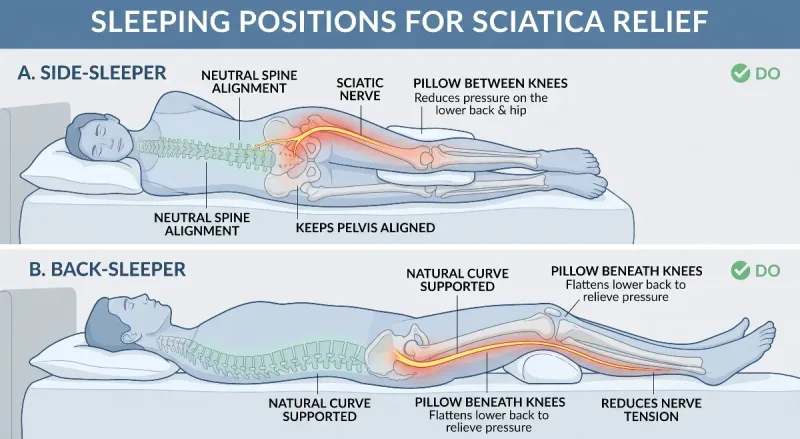
1. Side Sleeping with a Firm Knee Pillow (The Gold Standard)
Best for: Disc herniations, spinal stenosis, and sacroiliac joint irritation.
-
Setup:
-
Lie on your side, preferably on the side opposite your painful leg (painful leg on top). If your symptoms prefer the affected side, that is acceptable as long as you feel zero radiating discomfort.
-
Bend both knees at a comfortable 45- to 90-degree angle.
-
Place a medium-firm, contoured pillow between your knees and calves—extending from your inner thighs down to your ankles.
-
-
The Biomechanics: The pillow prevents the top leg from dropping forward and collapsing toward the mattress, keeping your hips, pelvis, and lumbar spine in stacked, neutral alignment to prevent sciatic nerve tension.
2. Back Sleeping with Knee Elevation (The "Zero-Gravity" Psoas Release)
Best for: Degenerative disc disease, facet joint irritation, and general lumbar disc bulges.
-
Setup:
-
Lie flat on your back (supine).
-
Place two standard sleeping pillows, a wedge pillow, or a rolled memory foam bolster directly beneath your knees.
-
Ensure your heels rest lightly on the mattress or a small towel roll while your knees remain bent at roughly 30 to 45 degrees.
-
-
The Biomechanics: Elevating the knees flexes the hips slightly, flattening the lumbar spine against the mattress. This widens the neural foramina, takes tension off the iliopsoas muscles, and eliminates pressure along the sciatic roots.
3. The "Quarter-Turn" Pillow Hug (Supported Fetal Posture)
Best for: Central and lateral lumbar spinal stenosis.
-
Setup:
-
Lie on your side and draw your knees gently toward your chest in a loose fetal curl.
-
Place a flat pillow between your knees.
-
Hug a firm body pillow or large king-size pillow along your chest and stomach to prevent your torso from twisting forward onto your belly.
-
-
The Biomechanics: Flexing the spine forward into a gentle curl mechanically opens the spinal canal and foraminal openings, creating maximum breathing room for irritated nerve roots.
The Position to Avoid: Stomach Sleeping (Prone)
Sleeping flat on your stomach is the most aggravating position for active sciatica:
-
It forces your cervical spine into extreme rotation for hours just to breathe.
-
It flattens the thoracic spine while creating an excessive backward arch in the lower back (hyper-lordosis).
-
This hyperextension pinches the posterior disc walls and compresses exiting nerve roots, making morning leg burning far more severe.
Exception: If stomach sleeping is an unbreakable habit, place a flat, supportive pillow directly beneath your lower abdomen and pelvis to prevent your lower back from sagging.
Pre-Bed Decompression: The 90/90 Chair Rest
Before climbing into bed, spend 10 to 15 minutes in a restorative decompression pose to quiet angry nerve pathways:
-
Lie on your back on a firm carpeted floor or yoga mat.
-
Rest your calves and feet flat across the seat of an ottoman, couch, or chair so your hips and knees are bent at 90-degree angles.
-
Place a thin pillow or rolled towel under your head for neck support.
-
Rest your arms comfortably by your sides with palms facing up, taking slow, deep diaphragmatic breaths.
-
This position reduces lumbar intradiscal pressure close to absolute zero, relaxing the lower back muscles before sleep.
Medical Disclaimer: The positions and guidance provided in this article are intended strictly for educational and self-care purposes and do not replace personalized medical advice, clinical neurological testing, or physical therapy. Sciatica can stem from serious spinal conditions requiring immediate medical or surgical attention. Seek emergency medical care immediately if you experience "red flag" symptoms—including loss of bowel or bladder control (incontinence or retention), progressive muscle weakness causing your foot to drag or slap the floor ("foot drop"), numbness or loss of sensation in your groin and inner thighs ("saddle anesthesia"), or unrelenting pain accompanied by high fever.



Comments
No comments yet. Be the first to ask a question or share an update.
Leave a comment
Your mobile number is never published. Comments appear after review. Website links, email addresses and code are not allowed.